BROWSE Columns


✕


If your artistic journey were a collage itself, what fragments would be layered?
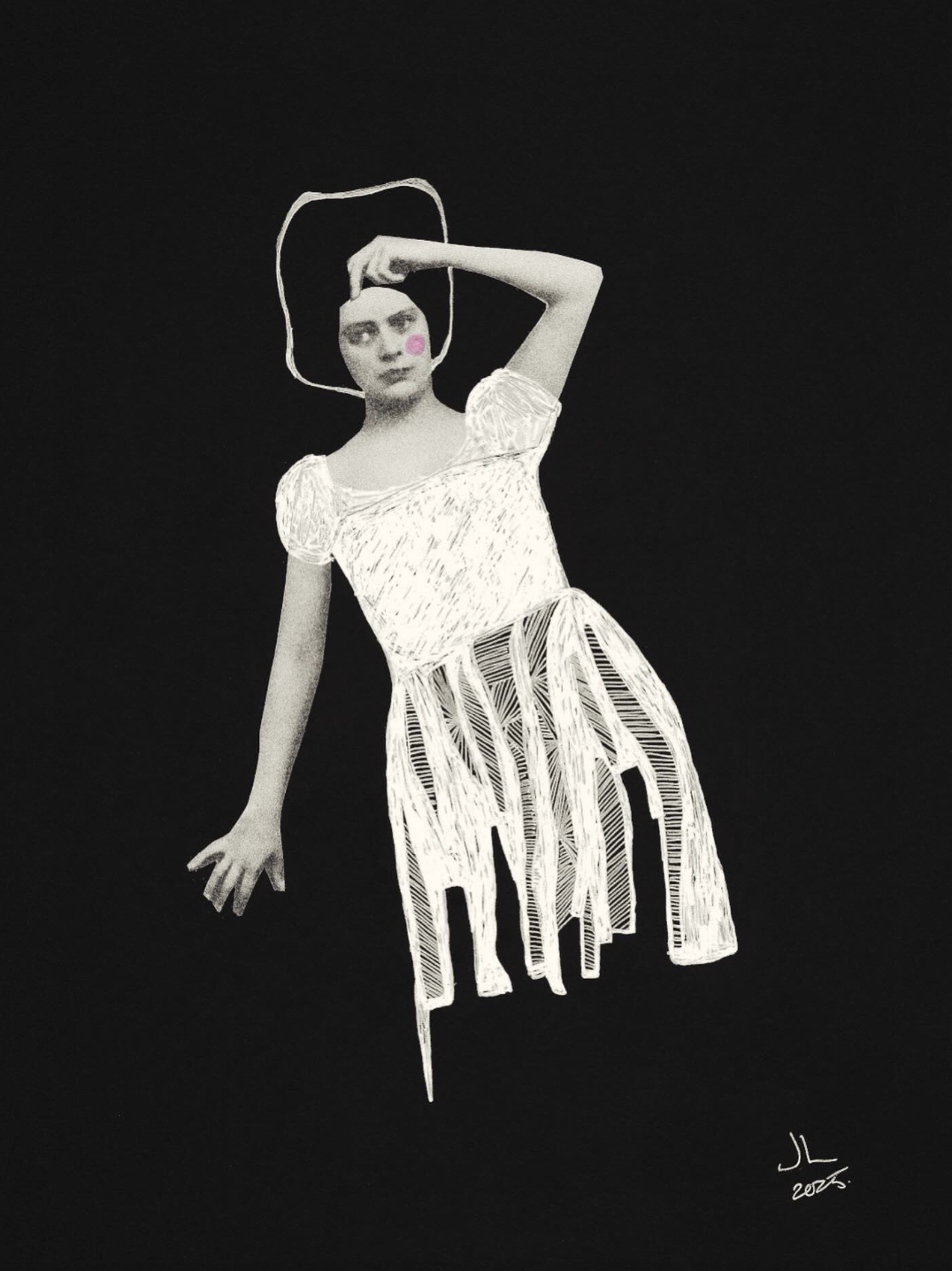
Cinema would be at the center: faces, attitudes, gestures, moments caught between intention and accident. There would be hands, threads, textures, evidence of making. And beneath it all, fragments of memory, things half-remembered, half-invented.
Do you think about collage in a similar way as you think about cinema?
Collage and cinema both begin with what already exists. You're never starting from nothing: you're negotiating with images that already have a history, a light, an internal logic. That feels the same to me whether I'm in an editing suite or at my table. The cut is where I feel them meet most strongly. Not as a technical operation but as the place where meaning appears. In both practices, what happens between two images is often more alive than either one alone. Where they part ways is time. Cinema unfolds. Collage suspends. But my collages still feel to me like frames pulled from a longer sequence, something that happened just before or just after the moment you're looking at. The temporality is latent, not gone.
Does your professional experience as a film editor feed your work as a collage artist, or do you tend to keep the two worlds separate?
The two worlds feed each other constantly, though my experience in cinema has perhaps been less typical than it sounds. For most of my career as an editor, I worked primarily with women or on feminist films and documentaries. That shaped me deeply. Editing taught me that meaning lives not only in what is shown but in rhythm, juxtaposition, the charged silence between images, in what is withheld as much as what is given. That sensitivity moved naturally into collage.
But collage gives me something editing rarely could. Even in feminist film, there is still a narrative pulling everything toward resolution. My own art film work — including the experimental animated short I am making now, built from collages set in loop — lives closer to collage than to conventional editing. The women in my work do not have to answer to a story that has already decided what they mean. They can stay ambiguous, unresolved — and that is not a failure. That is the point.
Does your personal history ever show up in your compositions?
Rarely directly, but it's always present. My background in film editing shapes everything: I think in fragments, in rhythm, in juxtaposition. Feminism runs through it too: it informs which images I reach for and how I approach representation, particularly around women and domestic space. And underneath that, something more subconscious: a sensitivity to what goes unsaid, to emotional undercurrents. The work tends to sit somewhere between memory and fiction.
Do you think memory is also maybe a kind of collage?
I don't think memory is ever accurate. It's already edited: fragments, distortions, omissions, reassembled into something that feels whole. Collage is just making that process visible. Making work doesn't clarify my memories. It makes them stranger. But that feels right to me: I'm not trying to recover something fixed. I want to stay close to the ambiguity, resist the pull toward a single clean narrative. The strangeness is part of what I'm after.
There's a long tradition of women's memories being dismissed or rewritten by others — history, medicine, domesticity. Do you think there's something specifically feminist about insisting on the fragmentary, the half-remembered, the strange?
What feels feminist to me is the act of taking fragments and reclaiming them, using them to tell our own stories rather than inheriting narratives that were shaped, filtered, and authorized by men. Women's experiences have so often arrived to us already interpreted, already rewritten through someone else's lens. The fragment resists that. It holds memory and silence, discomfort and resistance, all at once, without forcing them into agreement. I am not interested in resolving those tensions. There is power, I think, in letting images and figures stay partially open, as though they are still in the process of escaping fixed definition, still refusing to be fully named.
What draws you specifically to women and domestic space?
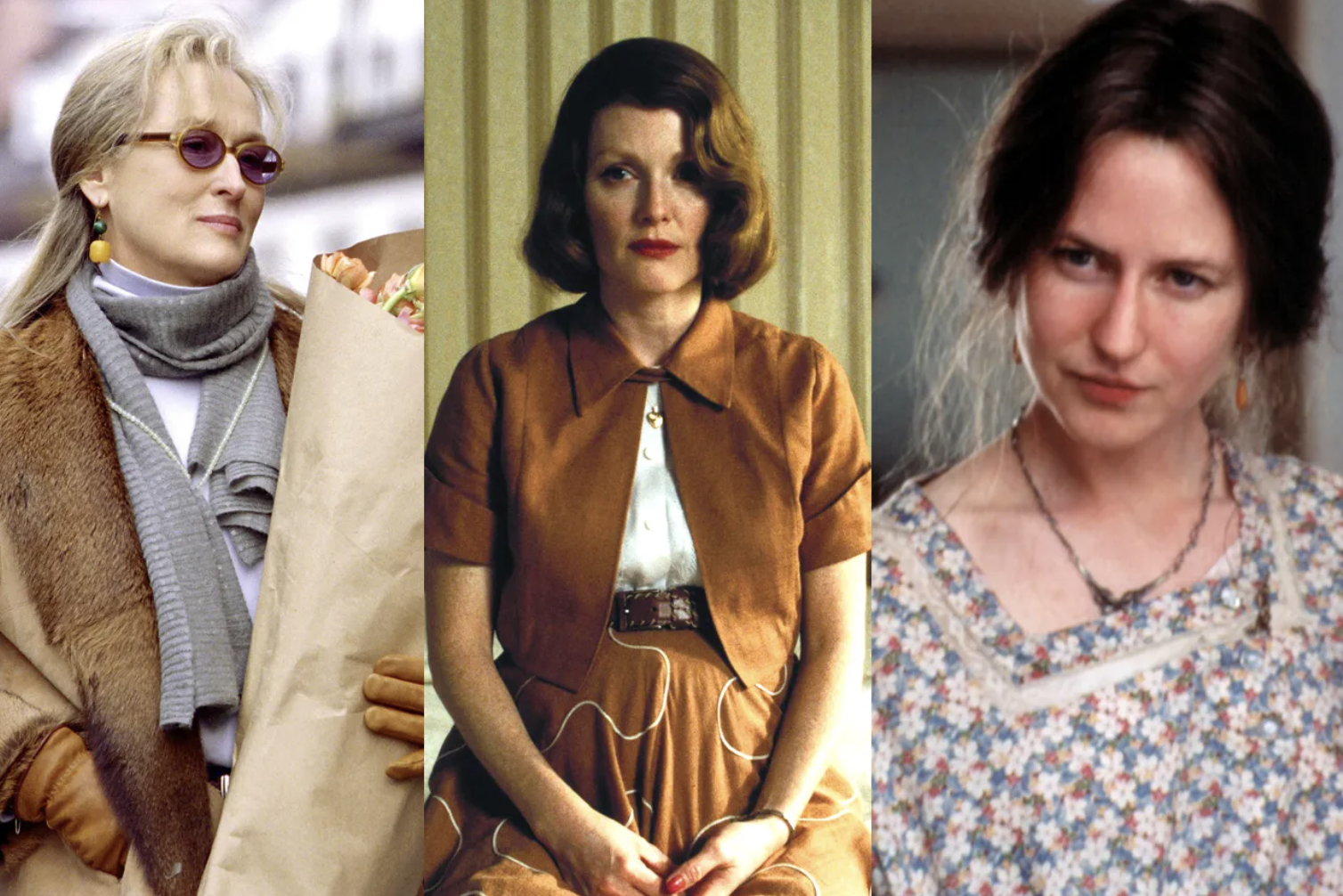
Those images carry an enormous charge, especially mid-century material, where everything is so staged, so idealized. But underneath there's tension: constraint, performance, a silence the images were designed to paper over. I'm interested in that gap. In taking familiar, reassuring representations and shifting them just enough that something less stable appears. And it's personal too, even if I don't always make that explicit. I couldn't have told you this before sitting down to write it, but The Hours (Stephen Daldry, 2002) might be the closest thing I have to a real inspiration for this work. Three women, three different moments in history, each caught inside a day that looks ordinary from the outside and is barely survivable from the inside. What stays with me is how domestic space functions in that film: the kitchen, the cake, the made bed — not as comfort but as a kind of pressure. Beauty and trap at the same time. That's the tension I keep returning to.
What draws you to collage as a medium specifically?
There's something compelling about recontextualizing existing images: they arrive already loaded with histories, codes, associations. I'm interested in that friction between what an image was and what it becomes. The process is also deeply tactile, and that physical presence matters to me. That said, I draw and paint within my collages too, so it becomes genuinely mixed media: a space where found imagery and hand-made gestures coexist and transform each other.
Where do your raw materials usually come from?
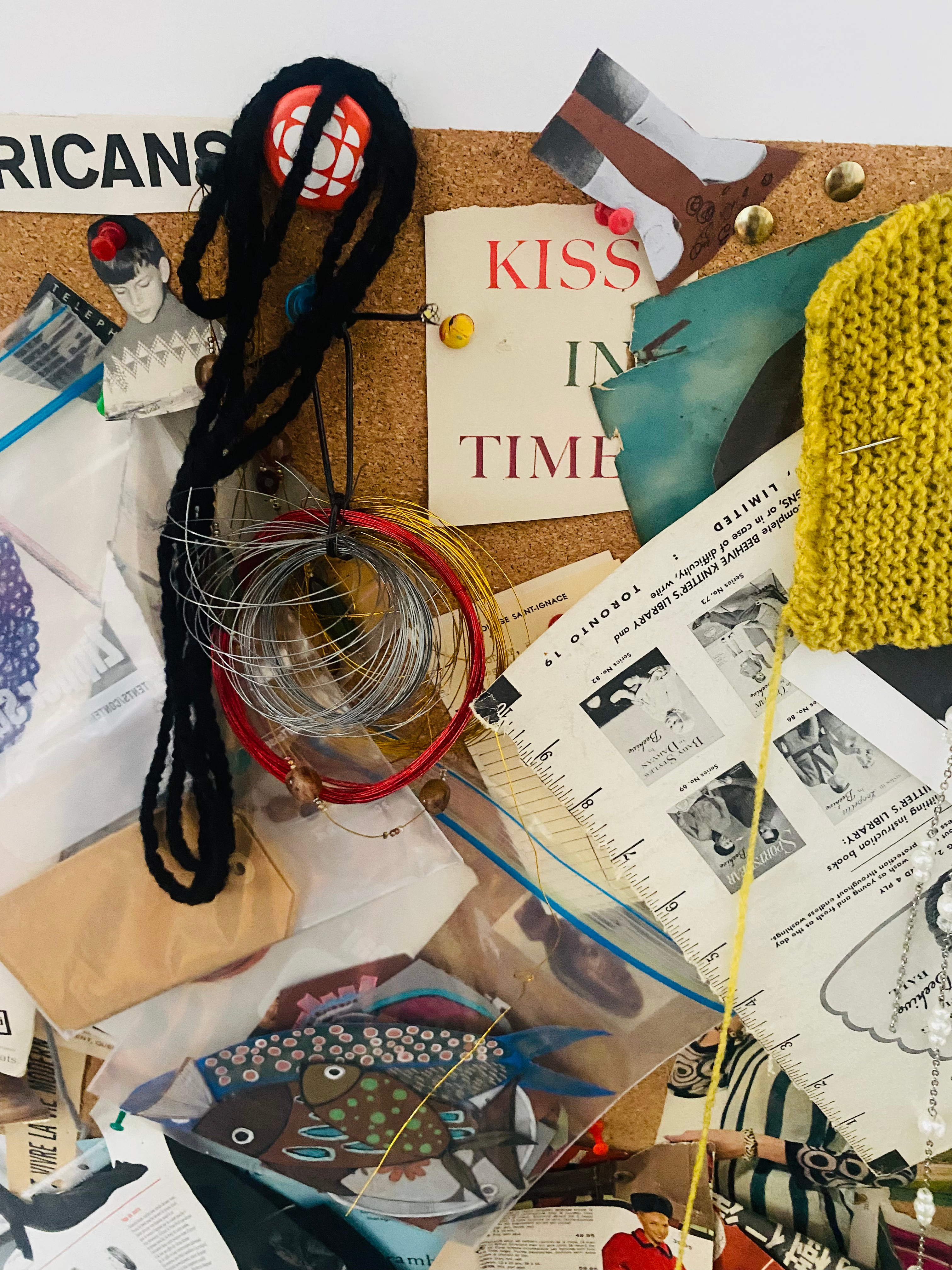
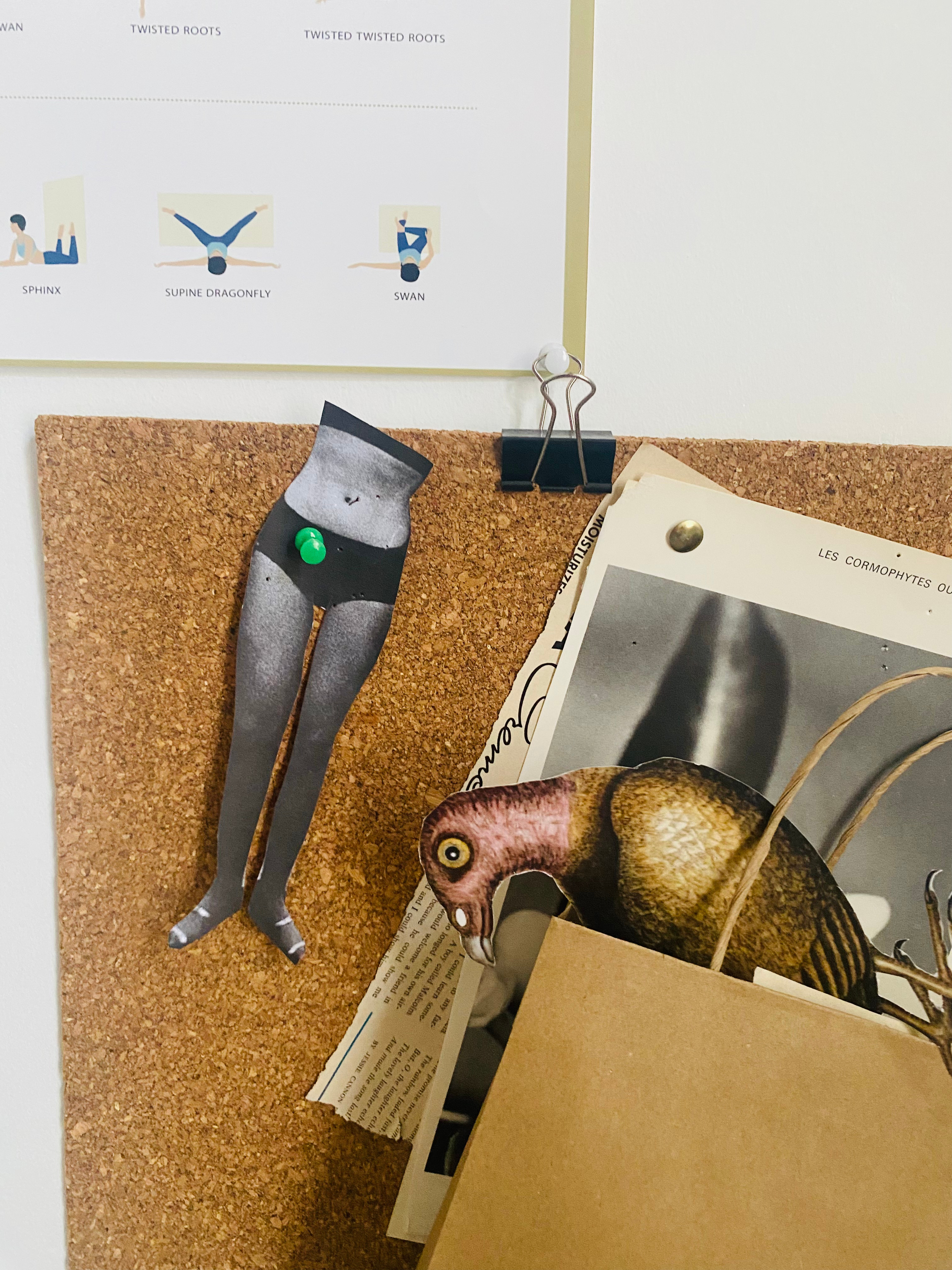
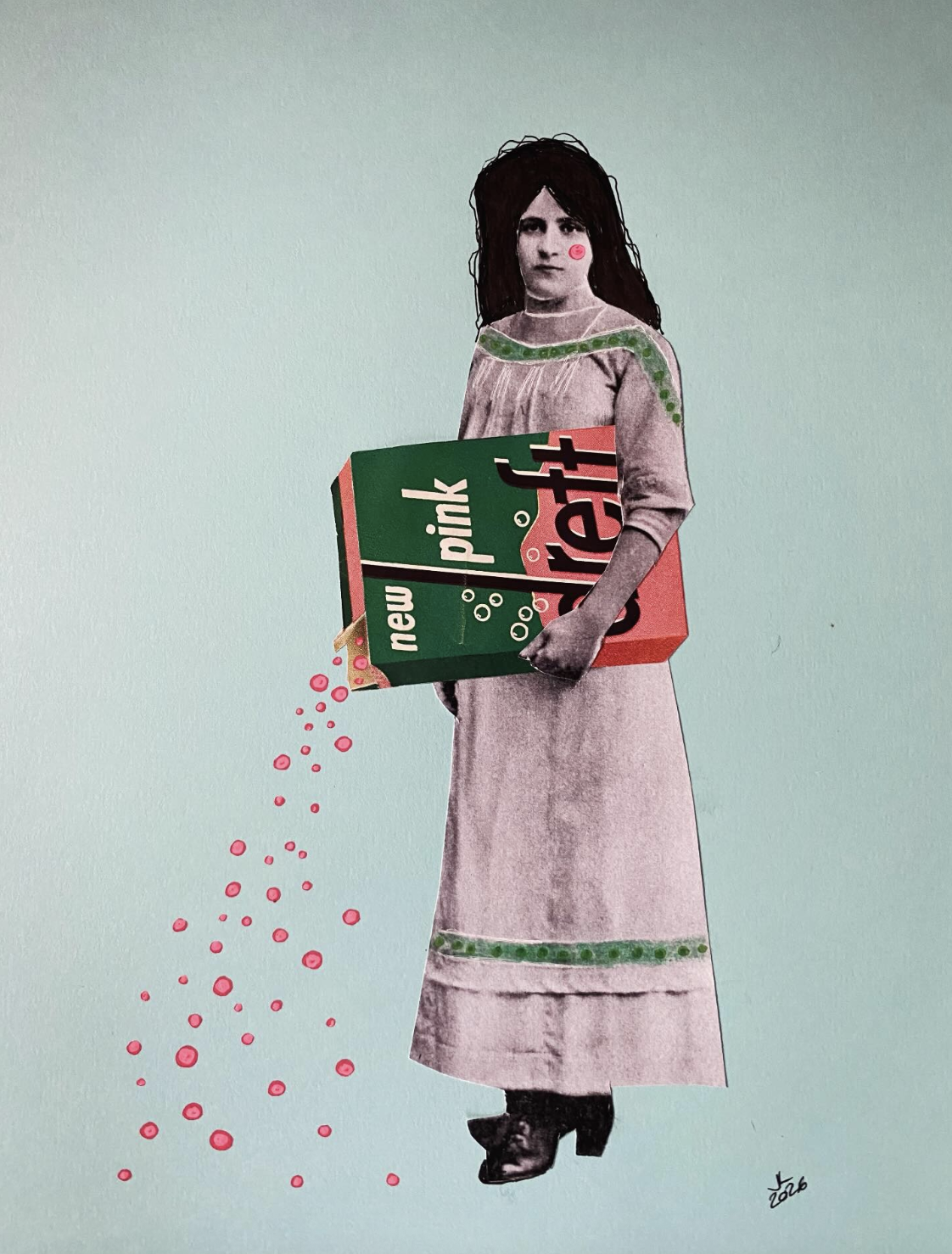
Mostly old magazines and printed matter, a lot from the 40s and 50s, a period with a very constructed visual language around women. The idealization, the control, the strange surface optimism of it. I keep loose categories — hands, faces, textures — but the choosing is always instinctive. Sometimes I don't know why I kept something until it turns out to be exactly what a piece needs. A lot of the work also happens in Photoshop before anything gets cut. I'll combine two or three faces into one, composite elements together, then print the result. So the "found" image has already been through a first transformation before it even reaches the table.
Those magazines were made to sell things — products, ideals, a version of femininity. When you remove an image from that context, does its original function disappear, or does it linger somehow?
I think the original function always lingers in some way. These images were created to sell not only products, but also ideas about femininity, domestic life, beauty, family and behaviour. Even after being displaced, they still carry traces of those values and expectations. I am interested in that tension. I do not want to completely erase the past attached to the images. The work often comes from the friction between the original context and the new emotional or symbolic space the image enters.
The Hours, which you mentioned earlier, is itself an adaptation — of Woolf, of Cunningham's novel. There's a chain of reinterpretation there that feels close to what you do. Do you think about your work as being in conversation with other works, or more as a practice of extraction — taking something out of its chain entirely?
I often come back to the phrase "nothing is lost, nothing is created" when I think about collage and cinema together. Both are built from fragments, from references, citations, images that have already lived somewhere else. Even transformation leaves traces. The origin does not disappear; it persists underneath, like a palimpsest.
I am not interested in extracting images from their history. What draws me is the relationship between fragments, the way new meaning can emerge from placing them in proximity, allowing different temporalities and resonances to coexist without resolving into one another. Collage and cinema both become spaces where images are never entirely new and never entirely what they were. They carry their past while remaining open to something that was not there before.
What's something you deliberately leave out of your work?
Resolution. My images don't explain themselves, and I resist closing the narrative. That gap is an invitation: it lets the viewer enter the work rather than simply receive it. I avoid anything too illustrative or literal; I'd rather hold tension than offer clarity. As a documentary film editor, I often tell directors to leave room for the spectator to move inside the film. I try to apply the same principle to my visual work.
On your process: do you start with an image, a feeling, a question, or something else?
I usually start by inventing a character. I remember my screenwriting teacher saying: everything starts with the character. That stayed with me, and it's still true in how I work — the figure comes first, and the story builds around her. The intention exists but stays open. I need room for accident, for misalignment, for things that don't fit, because the work almost always gets interesting exactly where something doesn't. It's a negotiation between direction and surrender. Too much control and the image closes. Full surrender and it loses structure. I try to stay in that uncomfortable in-between.

What feeds your work outside of visual art?
Film feeds my work constantly, rhythm, framing, the way meaning can shift with very small changes. I'm also drawn to fragmentary or essayistic writing, texts that hold space open rather than closing things down. When I started knitting three years ago, something shifted in how I think about slowness. There's a rhythm to it that's almost meditative, repetitive, unhurried. I think it changed how I look at images too — what an image gives up when you stay with it longer than feels comfortable. The artists who send me back to the table are the ones who trust the viewer, work that feels precise but not overdetermined, where you sense the intelligence without being told what to think.
You talk about knitting changing how long you stay with things. We live in a moment of extreme visual acceleration — images consumed in seconds. Do you think your work is partly a resistance to that? And what do you think we lose when we don't look slowly?
Knitting and drawing by hand changed my relationship to time in ways I did not expect. They slowed me down. They made me attentive to repetition, to gesture, to the strange experience of duration, of staying with something long enough for it to change. We live surrounded by images designed to be consumed in an instant and replaced by the next. I think something is lost in that speed. Not just attention, but a certain quality of encounter — the kind where discomfort, memory, and contradiction have room to surface.
Looking slowly is its own practice. I want the work to ask that of the viewer: not to receive an image immediately but to wait for it, to let it arrive. An image that reveals itself gradually is a different kind of image than one that delivers itself all at once.