BROWSE Columns


✕
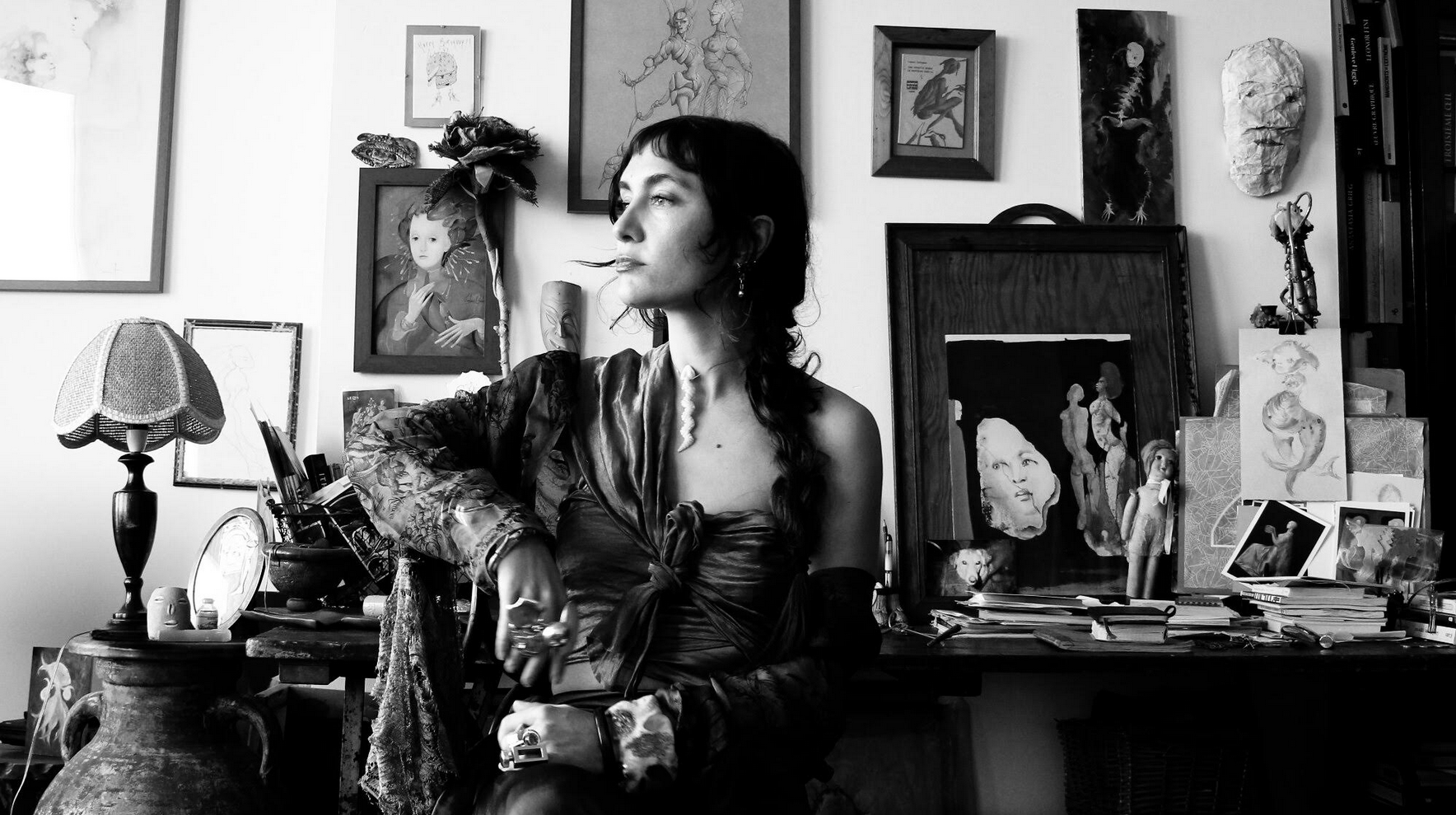


Micaela Brinsley: How has Amurmur evolved since you launched it?
Alexia Marmara: It is now just shy of three months old. I am so astounded and surprised by just how many people or how many things I can connect to conversations regarding memory. Sort of like when you hear about something for the first time, or when you discover something, it’s like you’ve etched it into reality and start to see it everywhere. There is also quite a zeitgeist thing about memory at the moment, that I was [already] very aware of through my work in archives.
I am continually really surprised by the amount of people, curators and writers, who are really excited to speak about the backstory of their project and what or who inspired them to bring it to life.
I write in such an emotional way as we know, and I am honoured to see that contributors aren't shying away from that either. I'm making a lot of friends, whether they know it or not. I'm kind of falling prey to the beauty of the ‘behind the scenes’ side of all of this. But what I’ve also realized is that I already had an inclination to compare archiving to health, research to falling in love—it's about care and being obsessed.
We've spoken about this obviously, you and I, but I actually realized just how in love I get with it all. So that's been really special, how organic it’s been.
It’s kind of weird now to imagine a life without it.
What was I doing before?
That’s so exciting to hear and now, you’re about to host your first Amurmur event! How are you feeling about it?
First of all, I wanted to do this launch event because I needed to present part of my personal research project on a Mexican artist (1938-1991) called Froylán Ojeda to the grant body that gave me the money to be able to go to Mexico. As part of the grant, I had to either put on an exhibition of his work, or give a talk. As we have discussed, I didn't gather enough information that felt like it would be compelling enough to give a classical presentation. What I found out was the experience of someone's life and the way people held his story, one almost disappearing, that really touched me.
On my way to Mexico City last February, I realised I was already terrified of not reaching the desired outcome. I wanted a film to be made out of this. I spontaneously contacted an e-friend, Ximena Prieto, whose work I admired. I wanted her eyes and words to bring the memory of Froylán closer to me. She brought in her friend and collaborator Ines Barquet who carried in her own magic too. Beautiful coincidences kept following the three of us, separately and together. The film grew roots with and without me when I was back in the UK. They put this beautiful film together, which is 15 minutes long. To add to the screening, I thought I could also do a reading of some of the letters I’d written to him too, an intimate exchange after my return from his home.
I wanted also to place Amurmur in context and have it be something that also exists within us all the time. Not just a platform online. I didn't want to make a PowerPoint presentation where I walk people through the ins and outs of my project. I wanted contributors of Amurmur or people who are about to, or people who never will, but should—to share theirs too. I wanted them to have a space to actually realize who they were in regards to their projects or art pieces. It's still taking this kind of behind the scenes approach.
I had the idea for Amurmur [for a while] but it really launched when I realized that I was doing this in honour of this amazing person in the world, named Roger K Burton, who recently passed on. Also, I was grieving so much this year—it wasn't necessarily people as much as feelings. I lost control of my own body and I became disabled and very very ill. Very tired and I lost a lot of my mobility. I lost that and I am grieving that all the time, but because there's pain it's not like I can grieve it emotionally because I'm just focusing on how to make the pain stop. Also, I had friendships that blitzed completely unexpectedly in silence and I’m grieving those too.
I was going through all these different channels of missing things. Missing feelings and missing sounds and Amurmur became this cushion. Everything became softer, because I was creating a space where I could speak about the different avenues of archiving and just be really honest about it, inviting others to do so too.
This event is probably also subconsciously a way for me to invite the people who might not have the time or the ability to read the website. Reading is a difficult thing in this day and age. No one has time for it. We're all so freaking exhausted that sometimes when we look at a screen, we just want it to be passive.
Sometimes we also just want to look at paper and not a screen.
Exactly.
So I also needed the space for there to be a voice. An actual decibel. Show people what has gotten me through all this grief. This notion of archiving in this context, with Froylán, is also the fact that there's a memory of someone I've never met that I actually 100% have fallen in love with—because of how the search has made me feel. I'm more alive than I ever was when I realized that while my life is changing, I'm unearthing someone else's. A symbiosis of his life and death and my own life, a survival mode I could upkeep whilst speaking to the thought of him.
So much more of my experience has been with moments and bits in archives that no one else has looked at. Or, with a character in a book who is so beautiful to me because I see so much of my world within that character. It's uncomfortable to tell people I’m somewhat emotionally involved with a ghost, or even my imagination of that person right now. It's physical, at times. It's such a rush.
When people leave, change or when people cause change in your own safety, you're allowed to also experience a desire to stop that feeling from happening. You can store things, stop them from being gone forever. It's almost like this reverse thing with me and this artist. It's not that he was in my life and left, he wasn't in my life but is here forever now, because I can't lose him. I'm the one who found him, the one who decided that he was gonna be found by other people. He was never the sense that I have of him, because I'm the only person experiencing him in this way.
I wonder if that's another way of saying that there is something in him that spoke to some part of you in an unnameable way. Falling in love doesn't just happen with a person—it can be with a feeling, a color, a sensation, a place. It seems in your study of this artist, you went through psychological, emotional, even chemical turns—but you followed your impulse to continue forward. To hold onto this search as a reflection of you.
Yes.
You earlier brought up this idea about the relationality between health and obsession. In my experience, when I’m obsessed with something, it’s pretty close to the sensation of hunger—as if there’s a space I’m searching to fill. This feeling can move inside continuously, which struck me as eerily similar to how you were describing this moment of following an artist in a year in which you felt such changes about the scope of your body. I’m wondering how you feel about notions of health as a word, disconnected from whatever interpretations other people have of it. What does it mean for you to be healthy at this moment?
Oh my gosh, what a beauty. No one has ever asked that question—you can actually write that down. It's funny, healthy to me means feeling completely not judged.
Wow.
It's feeling like I can be a person that suffers but walks around showing the physicality of it and absolutely not care. It's not being judged or not feeling ashamed that I've lost half my hair. It's not being judged or feeling ashamed that there's a collapsible walking stick in my bag, just in case I feel dizzy. It's not feeling judged or shamed by my own self because I've forgotten to take the myriad pills I have to take 15 times a day. It's also not being judged or shamed for not looking sick—going to a doctor and being judged by how ‘good’ I look, therefore not sick enough. It’s about not feeling judged for saying the wrong thing at the wrong time just because your brain was focusing so hard on keeping the person opposite you comfortable. I feel a lot of frustration in my illness as it has forced me to be a very different person than who I naturally am, and there’s a lot of irritation and confusion when you’ve had to take a back seat, one where you’re just managing and mending rather than fully experiencing.
Health is a million things. A million pains. A million griefs.
But so much judgement comes with it, in so many different ways.
For me, health is abandoning every single ounce of judgment that I have within myself, towards myself—then I’ll feel healthy.
The pain is another thing—it’s a handbag to the shame.
Wow that was so beautifully expressed in so many ways, thank you. It's really fascinating that health, which we tend to conceive as an observed measurement about us, is something you’re describing as intimately connected to the individuality of a person. That feels also so connected to the mission of Amurmur, as a space where people can recount their relationship with something through whatever artistic means feels right to them—and feel held in the process of doing that.
This all connects to something I wanted to ask you, which is the notion of romance and sex in relation with the archive. You sent me some materials about it in the context of the event before this conversation, and my response implicitly is that there are tons of different types of sex—so what kind were you talking about? If health is about feeling vulnerable without the lashings of judgment, how does romance intertwine with that, in a way that ideally isn’t too cruel?
I started realizing that this project was romantic when I started feeling like Froylán and I were dancing. It was intoxicating. These steps of serendipity and coincidence were leading me. I felt like I was being led by this person who's telling me, this is right. But then there were so many moments where I'd lose such confidence in my steps, because I wasn't receiving a sign. I would spiral a little bit and think, what's happening now? Where am I going? Am I doing the right thing? It felt like twirling, and I'd be in a completely new direction. Or, I'd be thrown into a new direction by a different clue that would then cancel all my earlier research. Or I would get one grant, but not get the other grant. I'd have this feeling of swaying. That's when I started realizing that the romance was that there were two of us doing it.
It wasn't me— it was me and him, which felt even more romantic. I speak about this in my letters to him, that I didn’t know who this person was. I was really confused by the fact that his name or their name (because I had no idea who they were), was Froylán. It sounded like Fraulein and I was persuaded, I was persuaded he was a woman.
I was adamant that there was no way that he could be [a man]—my experience with men is that I'm not often particularly impressed. I didn't think that a man would be able to do this, it didn’t seem like that aura.
It wasn't the color of the eyes. It wasn't the voice that kind of gets you when you have that crush and you're suddenly, for two seconds, you feel like maybe I found your person. It wasn't any of those physical things, which was weird because I'm very visual. But I've always gone for someone's spirit rather than physicality anyway, because I want to see the tick. That moment when you start realizing someone has a tick and then you're begging for that tick to come up over and over and over again in conversation—because that's just that tick that you want, and you’re left with waiting. I kept waiting for responses from grants or new clues or responses from his nephew or people who knew him in Mexico or archival centers that did or didn't have any of his papers.
The romance was even more amazing because it was like a treasure hunt. I really had no idea what was at the end, but it also started feeling very strange when I felt I'd completely lifted the dust of the memories belonging to people who knew him, and that I had disappointed him by not throwing him into superstardom.
The terms of the grant I received were to do this presentation, which I just couldn't because I hadn’t found anything academic to say about him. I couldn't even place him in an artistic context because he was painting surrealist scenes after the birth of the surrealist movement. There was no context that the rigidity of art history would embrace—so I felt a huge disappointment in myself. The kind that feels as real as when you make a really big mistake in a relationship. I don’t know, like if you cheat on someone or speak to someone else. Not that I've ever done those things, but I can empathize with the feeling of disappointment. The only way for me to evolve with that disappointment was not to speak to my friends after my trip to Mexico. To share that I felt I’d failed at my grant. I was calling myself a fellow and I didn’t make any altering discoveries—I didn’t tell anyone this. My friends kept asking, how was your trip? My response was always, it was so magical, it feels so personal that I can't relay it to you.
There was this innate privacy between Froylán and myself that made it feel like I was literally chasing a ghost. It's the most beautiful thing I've ever done with my life, but I couldn't, I couldn't share it because the only person I wanted to share it with was my person, this person Froylán, the person I was in this romance with. I also felt very few people would actually see how much it had changed me. That's when I started writing letters, because I needed to speak directly to him and tell him how I was feeling. Tell him what actually had happened between us, not in feelings, but in words.
I've been so weird about not telling people his name until the film comes out. But it's almost like a refusal to let people have an opinion on him before I present the thought of him, and the guiding force behind those thoughts.
Well, maybe releasing this film will make you feel confident and trusting in your relationship with him. So, no matter how anything is received on December 18th, it’ll be okay.
Exactly.
I actually think secrets are really important. There's something really valuable about preserving a dialogue within yourself and something else that makes you feel a certain type of way. It's really moving to hear you discuss this unspeakability, this incommunicability, this lack of desire to share that you ‘learned’ something. Almost as if you passed under a wave that’s now moving through you, after you returned back to shore.
Absolutely.
Also, you know, it is funny because it might seem like I was being coy in not responding to the sex part of your question. In archiving, when you go to institutions, a researcher, whether they acknowledge it or not, if it's a personal project, they're falling in love. It's a search to understand. It's unquenchable. It's all you think about. It's the same kind of body response as attraction. When a researcher is accessing that object, you are wearing gloves so there's always this wall between you and the thing. You're still enjoying it. You're still taking down all these notes and loving it—but you're wearing gloves. You're wearing a knowledge condom, essentially.
When I was dealing with the work of Froylán, I wasn't wearing gloves. Therefore, my experience with him was even more intense because I was the person who was finding him, but also it was him. When I was touching [objects from] his archive, he had touched this too. His passport. His painting. So I say sex but I’m experiencing something, understanding a person, in a more profound way when it comes to research.
In any way, it’s also been confusing in a world where perhaps we do talk about sexuality and gender as this beautiful, unexplainable, but also theorized thing. Because I've never spoken to someone who also had an experience of someone falling in love with the memory of something that they’ve never met.
This man, he died the year I was born. I have never heard his voice. Never seen him move. We’ve lived completely different walks of life, at different times. He wouldn't have even been mildly attracted to me. He was gay. He was in a lifelong relationship with a man that he loved dearly, dearly—who died with him. So I never… I can only… there's nothing, there's no story.
Although I did pick up something the other day, Owlish, which I haven't started yet, but the premise is someone falling in love with the figurine of a ballerina.
With Froylán, it feels different. Am I in love with him or the way that his memory makes me feel? To find someone, to remember them, someone I’ve never met? Is it because I can't articulate what I'm feeling, why I'm so obsessed with it—or is it the other way around? Is it him? Is it his art?
Or is it the feeling of being more in proximity to these questions? It's also interesting, the way you described condoms in this relationality—because obviously in this dynamic you would be the person with the penis and him, not. Which is a reversal of what’s true, in ‘life.’ I don't know how much has been written about the relationship between gender theory and archival practices, but I think it’s fascinating to think about the archivist as masculine and the archive as feminine—energetically traversing that (heterosexual) binary. I mean, Susan Sontag even wrote a novel about this, called The Volcano Lover. I think the notion of an archive, the historical habit of protecting the property of people of the past by holding onto ledgers and information, documents, valuable things, is considered a very masculine thing. So I'm not going to call what you’re doing ‘drag’ because I think it's a little different, but it is a kind of intellectual drag.
A hundred percent. With that also comes the shame. Understanding that this is a perceptively weird branch of sexuality. The shame of falling in love with someone inanimate that I can't see. Adoring the world within their paintings. A desire for his dreamscapes. It's also, you know, shame about not being the kind of person that I know he would be in love with. A large premise of the film is about his complete understanding of women on a really deep level. We captured quite a lot of collectors and specialists voicing their surprise at the fact he painted with such a, dare I say it, feminine touch. Also, the shame of the colonial notion of accessing this archive in a country that's not mine, and the shame of having to fall back for months and move things at a very slow pace due to ill health.
You know, you question every bit of yourself when you're in a romantic relationship. Or, every mistake just feels so much bigger when you're in a romance. So there's this shame of having to write to him in my very, very sick state. From my grieving state, my heartbroken state. To feel that he would be the only person who would understand how intensely I was responding to his paintings. To know that he was actually not there, that he was living within me—so, was I talking to myself?
But that’s so beautiful.
It is. It's really beautiful, but when, if this book of letters ever gets published, what will his family think? His sister-in-law, who might think of me as this crazy girl who came to research her brother-in-law, who ended up writing a romantic series of letters to him, a gay man? I kind of picture myself writing these things to him so privately in the confines of my house, so removed from all my friends, that it’s strange. I have a few beautiful, amazing friends in the town that I live in, but I'm also very separate from everyone else. I'm very close in spirit but not physically close to my family who live in a different country. It can all make me feel so good while also making me feel really embarrassed.
Then I decided to put this event on, funnily enough.
I mean, you don’t have to judge yourself for that, though.
Of course, but we live in a world that shames any way of existing in ‘otherness’ or rebelliousness. Which is funny, I have a painting by Froylán over my desk that is called El Rebelde. It really reads like a self portrait, and in the bottom part of the painting you see him emerging from a jalapeño. Maybe that’s what I’m doing too, emerging from the strange fruit of all my branching labour.
But shame is only the result of judgement. I don’t think shame is within any of us. It's not that you have shame naturally as a person about this, because obviously your impulse was to investigate, to spend time with this person. There's also no mandate that these letters be published, no mandate that this short film has to come out, no mandate that anything comes out of anything. It's an urge that you followed. I think looking at yourself from the outside before you've even reached a point of clarity within yourself about the end of it is being overtly cruel, you know? It's amazing that you're doing these things.
But what will his family think? This can’t be what they expected?
The family will know it's not actually about him—it's about you. This is actually something so connected to another thing I wanted to ask you about, which is that (in my opinion) romance is the simplest Trojan Horse to construct in order to write about the self. Love songs, romance novels, poems, anything about devotion to another person, expressing feelings for another person, always allows us to explore something within ourselves about how we desire, or what we desire. Clearly, where you are now is a moment that your heart, your mind, and your body have led you to—and I really adore how you described it as a dance. It brings up questions like, is this dance about the moment of the dance, the privacy of it? Is the dance about getting to know your body or your mind or your feelings in the context of the dance, in order to stay there—or leave the dance for something else? I wonder if any of that resonates with you…
One hundred percent. It's funny, because the dance is everything that you've just said. It's about how it feels. It's about, you know, experiencing something where I feel so incredibly out of body but also inside of me. If I dance now, in person, I get tired after two seconds. But I'm not tired of this one.
It's a dance that's so different to everything else that I've experienced. It's newness. It's something inhabitual while I'm cooped up in my apartment waiting for the pain to subside. It's a dance that's also about me actually realizing that my understanding of research is my calling. It's not just something that I'm doing, but something I'm actually very good at—finding the things that people don't know about. I'm good at understanding them, I'm very good at caring for them.
As much as I talk about this shame, I’m also jokingly aware of the magic of what I’ve created and awoken. So I guess it's confusing, it’s exposing. In that sense, this project is complex and beautiful because it's the opposing parts of me that are meeting in the middle—combusting and excited and confused and embarrassed.
Also I think the notion of dancing also comes back to illness. First of all, I'm left-handed. So it was really difficult when I was a child to join a choreography, because I had to mirror people while also not following my intuition because leading hands were never the ones that I would want to lead with. You know, everything in life is kind of a choreography. If you meet someone for the first time in France, you give two kisses—one on each cheek to say hello. I always get the first side wrong. When we're saying hello, even though it's just an aunt or someone I've never met before, we do this funny head-banging, always led by me. I'm always the one making the mistake. I also became very aware of this dancing when I started getting ill and I couldn't do all the cool, fun things that all my friends were doing—I would be too tired. So I was never fully able to ‘dance’ the way that other people did. And I love dancing. When it's my own choreography, mirroring no one, I'm very good at it and I can do my thing. But never in a group context.
This choreography with a person that I was able to do, that I was actually really good at doing—it's special. So special to find yourself carried by a research project rather than carrying the research project, you know?
Totally.
I guess I am holding onto this because I'm carrying the research project, because I am bringing him to the surface. But actually, is it me bringing him to the surface or is he bringing me to the surface and I'm getting to show myself?
Obviously it's quite seminal that it's in this year that everyone claims is a huge one that changes you—33—one that moves you, one that will forever mark you, that starts a new chapter in your life. This year, that I'm having this dance with this person.
It’s marvelous.
Almost like an experience of surrender?
That’s definitely happening.
Also, what’s fascinating is that within the notion of surrender is also about its shadow—control. Archives were of course invented thousands upon thousands of years ago, but it feels also so connected to Enlightenment thinking, right? Pursuing knowledge as something tactile, that can be located. But also, you have this approach that’s also mystical, too, connecting to a more fluid notion of time.
I kind of remembered this the other day, when I came across a big pile of postcards of the Nice Carnival from the early 20th century. They're beautiful, so poetic and amazing. I'd collected them. They were so out there—there’s one of a woman riding a lobster. Upon researching these postcards and trying to understand what all the symbols meant, I realized that Nice and its inhabitants were representing big moments in culture and politics and history through these sculptures and chariots and costumes. Suddenly, all my history lessons made more sense, because there was an explanation of it through these people.
When I became an archivist in a magazine archive, I realized I was understanding history through subcultures or through fashion or through theater or through all these visual components. Through articles written by great thinkers, hackers or things that weren't given to me in school, I was starting to understand the different branches that can take a person. I loved that. I loved that within an archival context, I could read someone's firsthand experience as well as have my remembrance of that experience. All of these intertwined branches that made a moment in history. Within [the discipline of] art history, I found it confusing because I could be looking at a painting and feeling so many things in a museum, but then read what an archivist had written and most of what it said was the date and the context in which that painting was created. I didn't resonate with that because down the line, it's just someone who I don't care about, who placed the art in a certain context. And actually, I didn't really need to learn the exact date of something. I could learn an entire story, the alchemical process that brought it to life as you said, because that was far more interesting to me. That’s what brought me to work in the archive in the first place.
The speakers at the event, for example, feature these alternate pathways of enshrinement. Diana Quandour found this online dictionary of catskill slang used during the Great Expansion—then wrote a book using it. Maybe if you'd found it, you would have written a play. If another had found it, she would have painted a train. The [possible] responses to this one object could be so varied. Another friend of mine, Billie M Vigne, is responding to her embodied relationship with her van, the ultimate form of her personal resistance to illness. Another example of an unbeknownst archivist caring a lot for an object. I also invited painter Nneka Uzoigwe to read from her dream diary, where she freezes her own subconscious understanding of day to day occurrences. She has a very wise place in my life because she actually congealed me, archived me, in the shape of a candle, but also as a person carving wax versions of myself, when I sat for one of her paintings. She painted me strong and static, but also imagining new pathways for my life when my real-time existence was falling apart. Rachelle Francis is responding to her late mother's artwork by ultimately speaking to her through workshops offering mindful activities for anyone suffering or ill, unlike her mother who was disregarded completely and eventually died from it. She’s also reconfiguring their relationship. Whereas my response to her mother's art before, if I hadn't had it in Rachelle’s context, maybe I would have just made an exhibition about her art visually—not about what it could mean in memory’s sense, you know?
That's so lovely, and this event is also happening in the Horse Hospital where you worked, right? How do you feel about this launch moment coinciding with a place where you transitioned between the work you were doing before to where you are now?
First of all, my late boss, the founder of the Horse Hospital, Roger who I previously mentioned, was my biggest cheerleader. He gave me the role of curator because he saw that I was one. I had no previous experience, so he kind of believed in me before I did. When I mentioned my work, he would be amazed by the things I was doing and research projects I was going on. Doing this in his land, what he created, his legacy, feels like the biggest honour.
As a space, it hurts me. It's not one that I wanted to leave when I left it. His stepping aside from it and subsequently passing away meant that everything had to change with it. It’s extremely beautiful and incredible with different legs now but it's difficult and it's also very confusing to be in a space, in an event that I'm curating when I was the programmer there, but now it's not my job to do that anymore. It's beautiful and confusing, but also maybe the last conclusion to my grief is just putting it to rest there.
It's also another example of a place that I respond to in a very intense way. I've romanticized it. I think I remember the good more than I remember the bad. I was really attached to my job without wanting to face how difficult it was, how much it was kicking my ass.
As you said, even though Amurmur was launched in the midst of grief, I hope you’re able to enjoy, feel so good about how much you’ve already done. I mean, how many people have shared their stories, fifteen?
More, definitely. Also, some are in the process, in the very early stages where we’ve just started to speak about it. There’s probably around ten things bubbling behind the scenes.
People have been really special and beautiful about it—it’s really touching. Very unlike anything else, actually. This event is just an open invitation for people to find solace in stepping away from academia, to offer a space where people can explore what they care about. This also just began as a compilation of ideas that I thought I’d love to write about one day, that didn’t feel tangible. A way in which I’ve faced my grief or sadness in relation to some subjects, through placing my feelings somewhere. I hope that other people’s memories can continue to feel welcome in Amurmur, too.
I care so much about them all.
There's a line in the letters where I say, why is it that you chose me?
Did you know I'd care?

Alexia Marmara is a writer, researcher, archivist and curator specialising in uncovering and celebrating the unsung. She is the founder and editor of Amurmur, a platform showcasing artists and writers working alongside memory or archives. She is a recipient of The Jonathan Ruffer Curatorial Research Grant for a project revolving around a forgotten Mexican painter.

Micaela Brinsley is one of the co-editors-in-chief of La Piccioletta Barca and editor of interviews, as well as fiction and essays.


