The House Within the House: On Current Italian Poetry
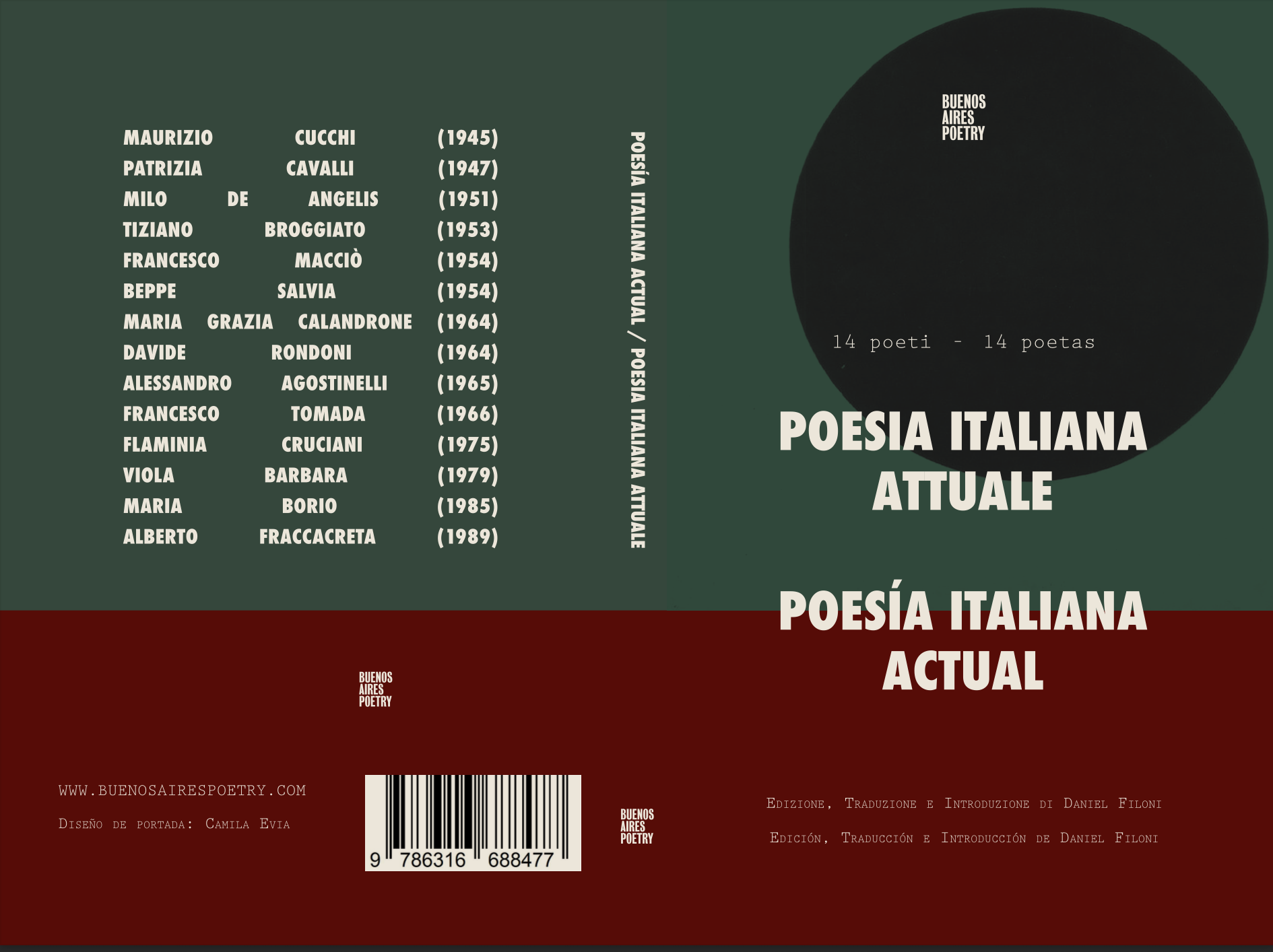
Every anthology is a wager, and serious wagers are always on meaning: for a word that does not spin in a vacuum, for a sign behind which something answers. When I closed the bilingual volume that Daniel Filoni has prepared for Buenos Aires Poetry (fourteen Italian poets born between 1945 and 1989, arranged in strict chronological order, like strata in an excavation), I understood that I was holding a book that makes this wager without blushing. In an era trained to suspect everything except its own suspicion, here are two hundred and twenty pages that sustain, with the serene obstinacy of the anachronistic, that the poem is still an act of presence: that when Milo De Angelis writes la parola data, the pledged word, someone or something is indeed pledged.
It is useful to date the strata, because this anthology can only be read against the backdrop of the tradition that produces it. Italian poetry reached 1975 (the year of Montale's Nobel Prize and his skeptical Stockholm lecture, Is Poetry Still Possible?) exhausted by two orthodoxies. First, the Hermetic: that religion of the absolute word which, from Ungaretti to Luzi, had made the poem an oracle, and which by the 1970s was already a monument, visitable marble. Second, the neo-avant-garde: Gruppo 63 and the Novissimi, led by Sanguineti, who had executed the lyrical self with the rigor of a tribunal and the fertility of a desert. Between the oracle and the laboratory, poetry had been left homeless. What happened next was a restoration that restored nothing: in the three-year period of 1974–1976, Patrizia Cavalli's Le mie poesie non cambieranno il mondo, Maurizio Cucchi's Il disperso, and Milo De Angelis's Somiglianze appeared (three books that returned experience to the poem without returning its innocence). Critics named the phenomenon two years later, when the anthology La parola innamorata (1978) gathered the new generation under a title that was a manifesto: the word, once again, in love (with things, with the instant, with itself), after two decades of processed word. It is no accident that Cucchi, Cavalli, and De Angelis open Filoni's volume; nor is it an accident that the entire selection rests upon the canon that Cucchi himself later fixed, with Giovanardi, in the Meridiani edition of Poeti italiani del secondo Novecento (1998). The anthologist anthologized, the canon reviewing itself: there is a circularity there that the alert reader will note. I prefer to read it as one reads dynastic genealogies: canons are not inherited, they are contracted, like debts and fevers.
What do these poets seek? Filoni’s prologue offers a polemical answer: citing Alfonso Berardinelli (poetry as an "exercise of resistance on the margins, where language still dares to tell the truth against the saturation of media noise") and adopting from Alessandro Agostinelli, one of the anthologized poets, the dichotomy between poesia-facile and poesia-poesia, the book presents itself as a bulwark against consumer lyricism. But the dispute between the easy and the difficult is as old as the one that pitted the Hermetics against Saba, and if this volume were nothing more than a trench, it would not deserve this review. My hypothesis is different, and I draw it from a verb that is repeated from poet to poet with the persistence of a symptom: to inhabit (habitar). Macciò titles a book Abitare l’attesa (Inhabiting the Wait); Cruciani opens her section with "When the living inhabited me"; Borio sentences that "everyone inhabits as they think"; Salvia discovers inside his ruined house "another house, of shadow." Three generations that no longer ask the poem to transform history (Cavalli closed off that illusion from the title of her first book, with a modesty that was the highest form of pride), but rather to make it habitable. Here is the epochal shift: from the commitment of Fortini and the corsair passion of Pasolini, which demanded historical efficacy from the verse, to this earlier, humbler, and more desperate plea. Not efficacy: shelter. If the Italian Novecento was, according to the famous formula, the century of Montale's "line of the no" (the no to eloquence, the no to certainty), these poets essay a minimal, almost clandestine yes: one can live in the word, even if one can no longer live off it or for it.
See this issue in the two elder Milanese, magnetic poles of the book and heirs to two lineages that run through the entire century. Cucchi descends in a straight line from the linea lombarda that Anceschi baptized in 1952: the line of Vittorio Sereni and Giovanni Raboni, for whom the concrete thing (the tram, the furniture, the debris) is the correlative of consciousness. But while in Sereni's Gli strumenti umani objects still held the memory of war and labor, in Cucchi we witness the final chapter of this material history:
Gli oggetti sono cambiati, sono cambiato io. / Erano fatti per resistere, durare anche oltre noi; / […] Oggi sono lisci, lucenti, spettacolari / mucchi immensi di opulenza iniqua, / impermeabili, viscidi, io stesso / nel processo del tempo destinato / a questo oceano sgargiante di immondizia.
"Los objetos cambiaron, cambié yo. / Estaban hechos para resistir, para durar incluso más allá de nosotros; / […] Hoy son lisos, relucientes, espectaculares, / montones inmensos de opulencia inicua, / impermeables, viscosos, yo mismo / en el proceso del tiempo destinado / a este océano chillón de basura" (Vite pulviscolari, 2009).
Everything hangs on an adjective: impermeable. The objects of the past absorbed (they were "blotting paper" for affections and memories, the poem says); today’s objects let nothing through. It is Montale's objective correlative turned inside out: in Ossi di seppia, the minimal thing (the wall topped with broken bottles, the eel) could still cipher a destiny; in Cucchi's ocean of garbage, things no longer cipher, they only gleam, and yet (here lies the moral greatness) the poet does not exempt himself: that "io stesso" (myself) destined for the same ocean separates the moralist from the satirist. When in another poem he declares himself "innamorato e ignavo" (in love and slothful), summoning the exact adjective Dante reserves for those in the vestibule of Hell (those who did not know how to choose, whom neither heaven nor hell wanted), the Milanese flâneur reveals himself as what he is: a condemned soul who has learned to love his circle. No self-definition is more Lombard: the dialectal Delio Tessa and the Raboni of Le case della Vetra also loved their city this way, with the love of inventory and defeat.
De Angelis is the inverse pole, and his lineage is the other great subterranean river of the century: the Orphic line descending from Dino Campana and Clemente Rebora (the Rebora of Frammenti lirici, with his syntax tense as a drawn bow) toward the "poetica dell’inizio" (poetics of the beginning) that De Angelis himself theorized in the seventies in the journal Niebo. Where Cucchi accumulates residue, De Angelis pursues the instant when the absolute touches the minimal, and his distich from Quell’andarsene nel buio dei cortili (2010) is the cipher of the entire volume:
L’infinito appare nel poco, / come l’ultima nota di un grido / mentre si dilegua.
«Lo infinito aparece en lo poco, / como la nota final de un grito / mientras se desvanece.»
It is impossible not to hear here, inverted, the Leopardi of the idyll: if in L’infinito the siepe (the hedge that blocked the view) opened up to a sweet shipwreck in the immense, in De Angelis the proportion has become drastic: the infinite is no longer behind the obstacle but inside it, compressed into "two centimeters, between the body and the bar" of the high jump. Leopardi needed the horizon; De Angelis settles for the margin, and the same poem closes with the definition of poetics that should be engraved on the book’s pediment: "Poi la palabra che presenta se stessa, / l’interminabile parola data" ("Then the word that presents itself, / the endless pledged word"). Parola data: the promise, the oath. The poem as a pact whose counterpart does not appear and yet obliges. The entire Italian Orphic line, from Campana to Rosselli, fits within this double meaning; and it is no coincidence that De Angelis's major book, Tema dell’addio (2005), the great mourning song for Giovanna Sicari, has been compared to the Xenia Montale wrote for Mosca: two ways, the elegiac and the tragic, of sustaining a conversation with the dead that death does not interrupt.
Of Cavalli (who died in 2022, discovered half a century earlier by Elsa Morante), we must first say where she comes from: from Sandro Penna, evidently, from whom she inherits the grace of the epigram and the faith that happiness is noble material; but also from the "poesia onesta" (honest poetry) that Umberto Saba demanded in 1911 against the professionals of depth, and even from the Crepuscular Gozzano who made irony a form of piety. Filoni chooses with a steady hand: there is the poem about the line at the post office, where waiting in "a queue of almost / half an hour" is elevated to an exploit and the final syllogism executes the reader ("It is not a matter of self-love, / but of the horror of others / in whom I recognize myself"), and there is, above all, the prophecy of 1974:
Le parole / quelle moltissime / ma già non mi assomigliano più / hanno dimenticato la furia / e la maledizione, sono diventate signorine / un po’ malfamate forse / ma sempre signorine.
«Las palabras / esas muchísimas / pero que ya no se me parecen / se olvidaron de la furia / y la maldición, se convirtieron en señoritas / un poco malfamadas tal vez / pero siempre señoritas.»
Half a century before social media poetry, Cavalli formulated the danger against which this entire anthology rises: the domesticated, presentable word, devoid of curse (the word that has forgotten that in its origin it was an incantation). That the warning comes from the very heart of the chosen canon is the anthologist's greatest cunning: the book carries its own self-criticism just as codices carried their glosses.
Beppe Salvia is the wound of this volume, and anthologies without a wound are mere catalogs. His place in literary history is precise: the nuova scuola romana of the early eighties, the journals Braci (which he founded with Claudio Damiani and Marco Lodoli) and Gabriella Sica's Prato pagano: that handful of young writers who, after the ideological lead of the seventies, proposed the unthinkable: return to Petrarch, return to the sonnet, return to clear language. It was the so-called "ritorno alla metrica" (return to metrics), and Salvia was its martyr: he took his own life in April 1985, before seeing his first book, Estate di Elisa Sansovino, in print, signed with a female heteronym like a Pessoa of Umbertine Rome. His sonnet of the house ("All grey and battered, / with all its windows broken") loved precisely for its precariousness, culminates in two lines that enunciate, with the simplicity of the posthumous, the deep theme of the book:
Sembra d’aver / qui nella casa un’altra casa, d’ombra, / e nella vita un’altra vita, eterna.
«Parece que hubiera / acá en la casa otra casa, de sombra, / y en la vida otra vida, eterna.»
Poetry as a secret duplication of the real: the only house within the house. Salvia’s hendecasyllables, with those enjambments that break the breath (a formal heritage from the most syntactically daring Petrarch, filtered through the defenseless diction of Penna), do something that very few achieved in the century: they make metrics sound like the open elements. His "Questa è la nostra vita e nulla più" ("This is our life and nothing more") is the barest line in the book, and bareness, in poetry, is always the last thing achieved.
The constellation I will call sacred (Broggiato, Macciò, Rondoni, Fraccacreta) prolongs the third great current of the Novecento: the theological line running from the converted Rebora to Mario Luzi, by way of Betocchi, Turoldo, and the Testori of the laudari, and which constitutes the living refutation of the cliché that poetic modernity is necessarily atheistic. Broggiato, a Vicentine of the late Luzi generation, in confessed dialogue with the Nordic poetry of the threshold (his poem about "the Swede I brought with me," with the "tardy prize" that is an "announcement of brotherhood: / […] faith and poetry"), writes the most explicit ars poetica of the collection: the "necessary, irreplaceable" word sought among the swarm and finally found "lying on its side / on the roadside shoulder, dazzled, / run over perhaps, surely usurped / and yet luminous," gathered "like a wounded bird" and returned to "its chosen dwelling." The allegory is transparent and, because transparent, terrible: the word exists, but it lies run over at the edge of the road (usurped by advertising, by politics, by noise), and the poet's trade is no longer Orphic but Samaritan. Rondoni, founder of clanDestino and the Poetry Center of Bologna, translator of Péguy and Baudelaire, is the direct heir of Luzi (from whom he took the certainty that the poem is "earthly and celestial journey" at once) and of that Testori for whom flesh and grace were one and the same material. His litany is perhaps the text that best condenses the book's wager:
dammi l’albero- e dammi la parola albero // dammi l’incanto – e dammi la parola incanto // dammi il mare – e dammi la parola mare
«dame el árbol – y dame la palabra árbol // dame el encanto – y dame la palabra encanto // dame el mar – y dame la palabra mar»
The thing and its name, line after line, in a frontal rejection of the split between sign and world that linguistics imposed upon us as a coming of age. When the poem touches the Domine, non sum dignus of the liturgy ("I am not worthy but only say / a word... / and I shall be saved"), the genealogy becomes transparent: behind it lies the medieval lauda, Jacopone, and that very Italian conviction that Italian itself was born praying, in Francis’s Cantico, before being born singing in the Sicilian court. Rondoni does not imitate this tradition: he continues it, which is a different and harder thing.
Macciò contributes to this line the weight of history and the geography of another school: the linea ligure that runs from Sbarbaro and the early Montale to Giorgio Caproni (and Macciò is Capronian in his own right: he edited the volume of studies on the Livornese-Genoese poet prologued by Giovanni Giudici). From Caproni he takes the train, the vertical city, the eschatology of the platform. His journey toward Milan accumulates Po Valley toponyms and railway scrap until ending where every true European gaze ends:
Il respingente a fine corsa, / binario 21, carico merci, / vagoni piombati, / destinazione ignota. / […] Via Ferrante Aporti, / Fòssoli, Auschwitz, Birkenau…
«El paragolpes al final de la vía, / andén 21, carga de mercaderías, / vagones sellados, / destino desconocido. / […] Via Ferrante Aporti, / Fòssoli, Auschwitz, Birkenau…»
If Caproni's "Congedo del viaggiatore cerimonioso" turned the train into an allegory of one’s own death, Macciò turns it into a memory of administered death: platform 21 of the Central Station, the one of the 1943 deportations. Memory here is not a theme but gravitation: it bends every line as an invisible mass bends light. And that the traveler carries "the dry pulse of a tablet" and feels "a sting of pixels" in his chest says that this poetry does not oppose past to present: it makes them brake at the very same platform.
The poets of origin (Calandrone and Cruciani) constitute the incandescent center of the volume, and their genealogy is the most underground: the visionary feminine line that in Italy runs from Amelia Rosselli to Alda Merini, with Elsa Morante as tutelary mother. Calandrone (whose biography is already the stuff of Italian literature: her biological mother’s suicide when she was eight months old, the investigation of that wound in Dove non mi hai portata, a Strega Prize finalist) writes love as a geological phenomenon: "it would be reductionist to say love / this necessity of nature." There is something in her of Morante's Il mondo salvato dai ragazzini: the faith that salvation, if it comes, will come through the defenseless. Her poem of the universal tongue, where the word love parades in dozens of languages (Fekrì, hubùn, dashùri, sirèl, bhālabāsā, agàpi...) before the final stroke ("I, this nothing / fallen into the sleep of matter, will look after you / until the end of the world") proclaims that the search for a common tongue is "the true avant-garde, / the true prophecy for the future of the species": an answer to Babel that the Rioplatense reader will hear with domestic echoes, from Xul Solar's panlengua to Borges's analytical language of John Wilkins. Linguistic utopia is the heritage of both shores, and the bridge of this anthology travels in both directions.
Cruciani excavates in the opposite direction, not toward the species but toward the pre-human stratum of the self. An archaeologist by trade (she participated for years in the Ebla excavations under the direction of Paolo Matthiae; anyone who has seen the cuneiform tablets of the third millennium understands what it means for a poet to have held writing in her hands when writing was administrative theology), she applies the stratigraphic method to the soul: "When the living inhabited me / in the birth pangs of God"; "widowed hands dig within me / faces and bury idols"; up to the final mystical inversion: "When they called me alive / while I kept on dying." Hers is the most Campanian voice in the book (the Canti orfici throb beneath her visions like the Adriatic beneath Rimini), and her invitation, "Come, sit down, there is room in my mask / it is comfortable, it is made of flesh and bone," possesses that quality only the great visionary line possesses: it knows something about us that we did not know we knew.
The immediate present is occupied by Tomada, Agostinelli, Barbara, and Borio, and it is here that the anthology proves its nose, because the tendencies these four embody are the ones that will define the next decade. Tomada, a biology teacher in Gorizia, belongs to the lineage of frontier poets that the Italian Northeast has produced for a century: the Trieste of Saba and Slataper, the dialectal Grado of Biagio Marin. From Saba, precisely, he takes the essential: clarity as ethics, the "poesia onesta" that does not allow itself an extra adjective. His civil poem is the most memorable of the collection:
i confini dovrebbero essere come gli orizzonti / quando ti muovi si muovono anche loro / […] e patria è dove / un uomo pianta un melograno / e può aspettare di mangiarne i frutti
«las fronteras deberían ser como los horizontes / cuando te movés se mueven ellos también / […] y patria es donde / un hombre planta un granado / y puede esperar a comer sus frutos.»
Against the homeland of soil and blood (the one which on its mountain ridge "was Italy and Yugoslavia and then Slovenia," "a painful land of rancor"), stands the homeland of time: homeland is where one can wait. And his quatrain from Riconoscenza ("I don't believe in god / but you gave me a way to pray") stretches between the secular and the sacred constellations the bridge that theology would call, precisely, the prayer of those who do not believe: the very threshold where the Montale of "Iride" stopped, a believer in the sole epiphany.
Agostinelli, the theorist of poesia-poesia, turns out in verse to be the least solemn of all (lowercase letters, irony, geographies), and his melancholy humor comes from the Tuscan vein that Palazzeschi opened with Lasciatemi divertire: lightness as insubordination. His "Un lago d’Europa" ("how beautiful must have been / the life we did not live") inventories lives read (the Hispaniola, Borges with Crusoe, Bovary in the desert) to reclaim, against bookish resignation, "the desired escape / from editorial offices, libraries, and studies": a Cardarelli without the rhetoric of travel, a traveler who knows that the only ship available is syntax. Viola Barbara, from Livorno (and Livorno, land of Caproni and Modigliani, never produced solemn figures), introduces the language of conversation without conversation degrading the song; her internal filiation is clear and moving: she is the direct granddaughter of Cavalli, from whom she inherits the domestic theater of desire, updated for the screen era: "Promise me / you will never post again / the photo of a delicious dish, / because nobody cares at all / about our leftovers." Under the humor, an entire ethics (against the digital exhibition of life, incommunicable intimacy); and her final elegy ("time is a lightning bolt / and it steals space and life needs you / as foundations are needed / for a collapsing building") demonstrates that the minor key can carry the entire weight of mourning, as the Crepusculars demonstrated before her (those defamed figures whom Italian literary history has still not finished absolving).
Borio, finally, is the one who thinks the era, and her lineage is the most recent of all: the line of the mental object inaugurated by Valerio Magrelli in Ora serrata retinae: poetry as optics, the poem watching itself think. An editor of Nuovi Argomenti (the journal of Moravia and Pasolini: another demanding genealogy), an essayist of Poetiche e individui, she reads the Isola district of glass skyscrapers with the coldness of Duchamp’s Grand Verre which she herself summons, and her pandemic "red desert" (the title dialogues simultaneously with Antonioni and the zona rossa of 2020) carries abstraction to where abstraction rarely goes: to tenderness. Reduced to "a single point," the self asks if the lack of dimensions might not be fullness: "Thinking oneself is uniting oneself […] and a good, as never before, new?" Borio closes the circle that Cucchi opened: if he saw objects become smooth and impermeable, she already inhabits the entirely glazed world and searches, without nostalgia, for how to love within it. It is the difference between two generations and perhaps between two centuries: that of '45 elegizes what is lost; that of '85 furnishes what is there.
And Fraccacreta, the youngest (1989), a scholar of Montale and Luzi (his first monograph was significantly titled Montale errante. Cronache di una tensión religiosa [Errant Montale: Chronicles of a Religious Tension], a total declaration of lineage), closes the book with the most radical formal wager: the cycle "Maryam," which rewrites the Passion from the mother's perspective. Lyrical prose for Gethsemane; and for Golgotha, litanies of broken anaphora: "Tu ghisa di madre / Tu interamente scena" / "You cast-iron of mother / You entirely scene," whose genealogy is the oldest in the entire volume: the Stabat Mater, the laude of Jacopone da Todi, the "Donna de Paradiso" where for the first time in the Italian language a mother cried out at the foot of a cross. That this medieval form should flow, in the section "Gaza city," into the most atrocious present ("You Gazan / You strip of land / […] You under the rubble / […] You mother of those mothers") and fade out quoting almost textually the Apocalypse ("You will wipe away / You every / You tear from their / You eyes") says everything about the moral arc of the anthology: it begins with the Milanese flâneur of 1976 and ends at the foot of all contemporary crosses. Eight centuries after Jacopone, the lauda becomes once again what it was: the form the Italian language adopts when pain exceeds syntax.
There remains the essential: the translation, which is where the book stakes its being and where I confess to having arrived with reservations and left persuaded. Filoni has opted for the Rioplatense voseo and bases the choice on "linguistic hospitality" (the phrase is Ricoeur’s; the practice, here, is artisanal). The result is at times dizzying: Cucchi’s fatica turned into "laburo"; Cruciani's brothel-like battere resolved with the exact lunfardo term, "yirar"; Calandrone's grandmother’s cart turned into a "changuito"; Broggiato's wounded word lying "en la banquina"; and (the greatest audacity) Fraccacreta’s John the Evangelist running through the Kidron Valley as "el pibe," the infant Jesus called "el nene." There will be purists who frown at the "vos" addressed to the Virgin. I invoke in Filoni’s defense an illustrious and properly Italian precedent: Belli, who made the Gospel speak in romanesco, and behind him the entire tradition which knows that the sacred is not profaned by coming down to the street (it is profaned by staying in bronze). The 357 footnotes of this edition, which in fact constitute a second book within the book, a treatise on applied translation studies where every decision is argued and signed, do on the plane of language exactly what the poems do on the plane of the world: bring the word down from the monument, return it to the house, to the street, to the body. Add to this Borges’s "The Homeric Versions" (there is no definitive text; the concept of a definitive text belongs to religion or to exhaustion) and the case is closed: the translation that declares its shore is more faithful than the one that feigns to have none.
Objections? I owe them out of probity. The total absence of the experimental line (nothing descending from Zanzotto, whose laboratory of the Veneto and the lingua remains the other half of the Italian poetic sky; nothing of the poesia di ricerca that animates journals and collectives today) converts the promised "panorama of excellence" into the panorama of an excellence: the lyric. The leap between Salvia (1954) and Calandrone (1964) leaves blank precisely the decade of La palabra innamorata, and there are absences that hurt: De Signoribus, Anedda’s Residenze invernali, the Magrelli whose poetry of the mental object would have dialogued splendidly with Borio. And five women out of fourteen improves the historical averages of the Italian canon without correcting them. But reproaching an anthology for its absences is the laziest of critical sports; I prefer to judge it by the question it asks.
And the question is the same as always, Montale's in Stockholm: is poetry still possible? The answer these fourteen poets essay, each from their stratum (Cucchi’s shining garbage, De Angelis’s two centimeters of air, Salvia’s house of shadow, Tomada’s pomegranate tree, Fraccacreta’s Gaza lauda), possesses a coherence that makes one shudder: the word is the last habitable place, the house within the house. Filoni closes his prologue by citing Wittgenstein: we share the limits of language and, therefore, the same world. Permit me to slightly correct the formula, in the spirit of the book he prologues: we share the same world only as long as someone keeps pledging the word (l’interminabile parola data). As long as there are those who pledge it, and those who translate it with this mixture of philological rigor and shoreline tenderness, the old wager remains open. And open wagers are, in the end, the only way hope has found to survive criticism.
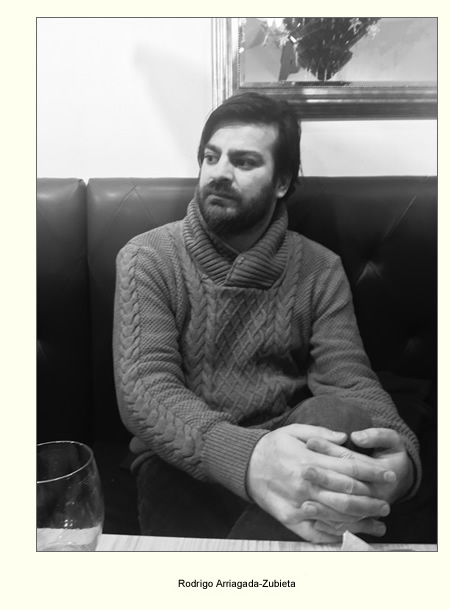
Rodrigo Arriagada-Zubieta (Viña del Mar, Chile, 1982) is a Chilean poet, translator and literary critic. He is Director of the Pippa Passes collection of the magazine and publisher Buenos Aires Poetry, a label that has published his trilogy made up of the books Extrañeza (2017), Hotel Sitges (2018), Zubieta (2019) and El Greco (2021). His poems have been translated into Italian, English and Bengali, published in media in Chile, Argentina, Austria, Bangladesh, Venezuela, Colombia, Peru, Bolivia, Ecuador, Mexico, the United States, Italy and Spain. His work has been anthologized in Chile by the Santiago Inédito publishing house under the title Una temporada en la cabeza (CL), 2020. In translation, he published Cutty Sark (Poesía escogida) by Hart Crane (2020) and Thirties Poets (2021) . He is currently finishing his doctoral studies in Hispanic letters at the Complutense University of Madrid. He resides in Alicante, Spain.


.png)