In July 1990, on the recommendation of Alejandro Manara, I was invited to the poetry school at the Naropa Institute in Boulder, Colorado. There, I shared an apartment with Mario Trejo for two weeks (Varsity Townhouse Apartments, Apt. 219), a very comfortable duplex. In the mornings, I assisted Jack Collom in his "Mistranslations" workshop, where the attendees and I back-translated into English from Spanish a series of translations I had done of Raymond Carver, having fun and marveling at the results.
At noon, I would go by myself to a food stall in an alley behind the institute, Daddy Bruce’s—a prefabricated wooden shack with a large counter and a few stools. The menu was simple: homemade hamburgers and pork chops with fries, and beer or soda. Afterward, I would return to the apartment, take a short nap, or read the poems of Ginsberg and Ferlinghetti, both of whom were readily available to clear up any doubts I had. From mid-afternoon onward, I would head to the institute to check the schedule, and then go for a walk in a magnificent park or visit an old secondhand bookstore, Aion Books.
The evenings were a succession of poetry readings, lectures, and roundtables that ended at 8:30 p.m. Afterward, I would either have dinner with Trejo at a Texan restaurant—where they served sirloin steaks, salad, boiled potatoes, and a bowl of soup for $9.50 US, beer not included—or go somewhere else with the students.
Ide Hintze, the Austrian poet, arrived when I was already settled in and discovered a liquor store that carried Trapiche products. Having found wine at a good price, we organized a few pasta nights—Spaghetti nights—in our apartment. They were attended by students from Ginsberg’s and Collom’s workshops, who were later joined by Ginsberg and Ferlinghetti themselves. The neighboring apartment was occupied by trumpet player Don Cherry, who would drop by with his Hollywood girlfriend after dinner.
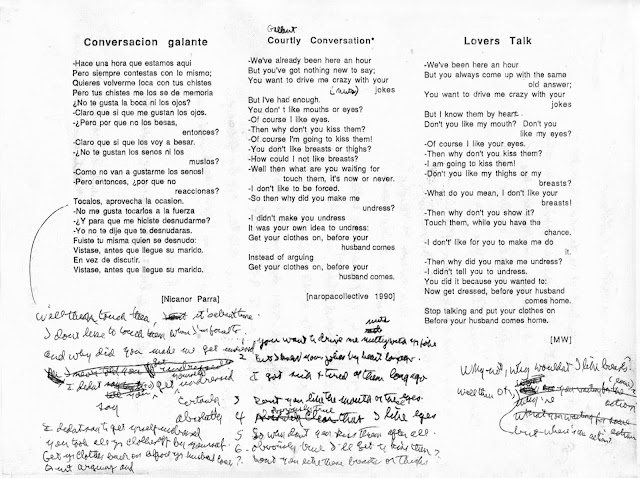
One morning around 8:30, someone knocked on the door. I woke up and went to open it; it was Ginsberg, coming in with a folder under his arm. He asked me if I would give him a hand with a translation of a poem by Nicanor Parra. I asked him for a few minutes, heated up some coffee, washed my face, and we got to work. Our lively conversation woke Trejo up, who murmured from his room in a clearly audible voice, "quién carajo hace tanto ruido!!!!"
When he came downstairs and saw Ginsberg, he calmed down and worked with us. Once the translation of Parra’s poem was finished, Ginsberg left to teach his workshop, leaving me a handwritten copy of our work.
Conversación Galante
-Hace una hora que estamos aquí Pero siempre contestas con lo mismo; Quieres volverme loca con tus Chistes Pero tus chistes me los sé de memoria ¿No te gusta la boca ni los ojos? -Claro que sí me gustan me gustan los ojos. -¿Pero por qué no los besas, entonces? -Claro que sí que los voy a besar. -¿No te gustan los senos ni los muslos? -¡Cómo no van a gustarme los senos! -Pero entonces ¿por qué no reaccionas? Tócalos, aprovecha la ocasión. -No me gusta tocarlos a la fuerza. -¿Y para que me hiciste desnudarme? -Yo no te dije que te desnudaras. Fuiste tú misma quien se desnudó: Vístase, antes que llegue su marido. En vez de discutir. Vístase, antes que llegue su marido.
(from Versos de Salón, 1962)
Gallant Conversation
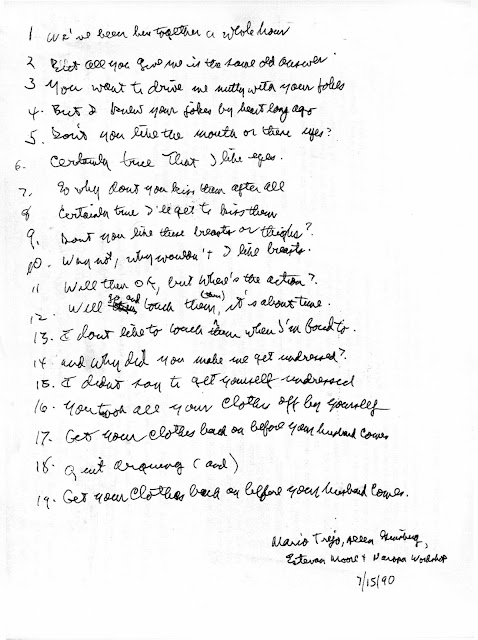
We’ve been together a whole hour but all you give me is the same old answer. You want to drive me nutty with your follies but I know your jokes by heart long ago. Don’t you like the mouth or these eyes? Certainly true that I like eyes. So why don’t you kiss them after all. Certainly true I’ll get to kiss them. Don’t you like these breasts or thighs? Why not, why wouldn’t I like breast. Well the OK but where’s the action? Well go and touch then, it’s about time. I don’t like to touch them when I’m forced to. And why did you make me get undressed ? I didn’t say to get yourself undressed you took all you clothes off by yourself. Get your clothes off by yourself. Get your clothes back on before your husband comes quit arguing (and) get you clothes back on before your husband comes.
(translation Mario Trejo, Allen Ginsberg, Esteban Moore; Naropa Work shop; 15 -7-1990.)
Draft text and final version, both handwritten by Allen Ginsberg.M.W. (Miller Williams)
An aside: One Sunday morning, Trejo and I went for a walk along Pearl Street, in what could be called downtown Boulder. The buildings on this street were all single-story. We were walking peacefully when the unpredictable happened. From above, something fell, gently brushed Trejo’s forehead, and landed on my chest. It was a playing card, the 9 of Diamonds. Trejo—I will always remember this—looked up, but as I said, it was a street of low buildings. He wondered how that card had come from above, "from the sky," he said. I still cannot explain it.
That night, Trejo handed me an envelope. Inside was the card, the 9 of Diamonds, glued onto a sheet of paper on which he had written a brief farewell note (which I still keep), because on Monday I had to go to Denver and catch a flight to San Francisco to meet Ferlinghetti.
Las Flores del Mall
Nueve diamantes sobre mi cabeza rebotan sobre tu corazón Compagnons de vagabondage The Rocky Mountains se abren como un decorado El Pacífico nos espera con sus olas abiertas Punto y Banca gana el nueve Nosotros somos el diamante
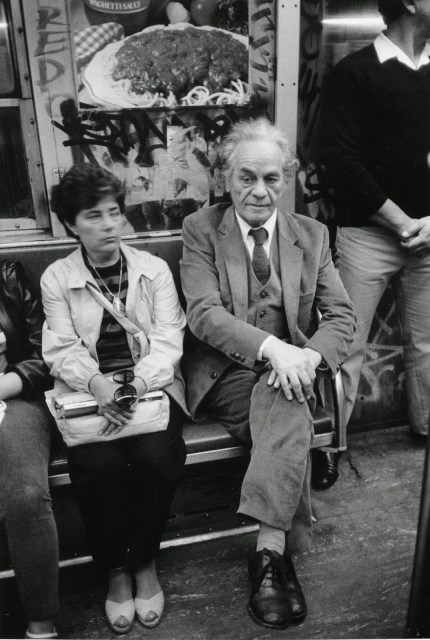
Esteban Moore (Buenos Aires, 1952) Poet, essayist and translator. His eight books of poetry are included in the collection Poems (1982 - 2007) (Córdoba, 2015). His essays are collected in the volume Versiones y apropiaciones (Córdoba, 2012). His poetic translations from the English include the poetry of Lawrence Ferlinghetti, La poesía como un arte insurgente (Córdoba, 2018). In 1990 he was invited to The Jack Kerouac School of Disembodied Poetics, Naropa Institute, Boulder, Colorado, where he initiated a translation project, and to Vienna, where he taught poetry and translation at the Schüle fur Dichtung in Wien. In 2005 and 2010 he gave seminars at the Escuela de Poesía de Medellín on the poetics of the Beats. In 2012 the University of Carabobo, Valencia, Venezuela, awarded him the Alejo Zuloaga Order in poetry. He serves on the boards of the magazines Prometeo, published by the Medellín International Poetry Festival and Poesía, University of Carabobo, Venezuela. He has won support grants and the Poetry Prize from the Fondo Nacional de las Artes, a public cultural institution run by the Argentine government.


.JPG)


.png)


