Phossy Jaw
■
Barely morning. The sun has already surrendered to a yellowing fog. Something chemical. Drifting. Persistent. Girls line the lane. A cough scrapes the brick like a plea. Only the pigeons answer, startled by something in the hurt of it. They will dip all day, these children. They will line up again tomorrow. Fewer of them.
■
The bone speaks last.
■
By the time the jaw declares itself — the swelling along the mandible, the wound that will not close, the face beginning to yield from within — the process has been working for months. The phosphorus vapor entered in silence. The bone died in silence. What announces itself to the eye is the terminus of a damage that needed no witness.
■
Phossy jaw. This is what they called it. Not in the medical journals — in the journals it was phosphorus necrosis of the jaw, phosphonecrosis, an industrial sequela in workers with occupational exposure. But in Bow, in the tenements, the word was worn down the way the girls were worn down. Phosphorus shed its syllables. The word arrived at what it needed to be: short, rough, close to the body. The disease named by the people who had it, not the people who observed it.
■
Phosphoros. Greek: φωσφόρος. Phos, light. Phoros, bearing. The light-bearer. In classical astronomy it was the name for Venus appearing before dawn — the morning star that carries light into darkness before the sun arrives. The Romans translated it: lux, ferre. Lucifer.
Lucifer was the brand name of the matches the girls made.
■
The Bryant & May factory stood in Bow, East London, on the banks of the River Lea — a tidal river running through a landscape of bone-boiling works, lime kilns, and chemical plants. The air above Bow carried sulfur. The matches were dipped in it. The neighborhood smelled of brimstone — the old word for sulfur, the medieval name for the fuel of hell — before a match was ever struck.
■
White phosphorus — P₄ — auto-ignites at 86 degrees Fahrenheit. It must be kept submerged in water or it combusts. In the factory the vats were heated to keep the phosphorus in liquid paste form, which raised the vapor pressure and suspended the particles in the air above the dipping surface.
The jawbone has the highest cellular turnover in the human body. It remodels continuously under the mechanical stress of chewing. White phosphorus mimicked calcium. The jaw accepted it. As the phosphorus accumulated, it choked the blood vessels feeding the bone tissue. The bone starved from the inside out.
■
The Bryant & May factory at Bow processed white phosphorus into paste and the paste was applied to the match heads by girls called dippers. They stood over open vats. They worked fourteen hours. The phosphorus vapor rose and entered the air and entered the lungs and settled in the jaw, in the alveolar bone where the teeth were rooted. Not at once. Over months. Over years. The body did not announce it. The body kept showing up.
■
A girl earning four shillings a week could be fined three pence for a dirty workbench. Three pence for dropped matches. Three pence for talking. The fines came off wages that were already a sentence. The arithmetic was designed to prevent the one calculation that mattered: what happens if I stop.
■
The dippers were largely Irish — daughters of the famine generation, still living in the residue of the 1840s, an underclass within an underclass. As the necrosis progressed, the dying bone produced a foul-smelling discharge. The girls wrapped their faces in rags to walk the streets. The disease isolated them from a city that had already refused to see them. The English poor would not sit near them. The pubs would not serve them.
■
In the dark of the East End tenements, the girls' faces glowed.
White phosphorus metabolized into dying bone emits a faint greenish-white luminescence. The necrotic jaw — the dead bone inside the living face — radiates in the dark. Families woke to it. A mother turning to see her daughter's face shining from the pillow. The jaw lit from within. The bone announcing its own death in the only language left to it.
The light-bearers were carrying a light they had not chosen.
■
Necrosis. From Greek nekros: corpse, dead body. The same root as necropolis — the city of the dead. The condition of the dead body inside the living one. The jaw was not dying. It had already died. It continued to occupy the face.
■
In 1844, chemists identified red amorphous phosphorus. Non-toxic. It did not vaporize at room temperature. It did not enter the bone. It could make a match.
Bryant & May acquired the British patent for red phosphorus safety matches in the 1850s.
They chose white phosphorus anyway. White phosphorus could be struck on any wall, any boot heel. Red phosphorus required a treated striking surface on the box itself. The margin was better with white. The girls were cheaper than the box.
■
When public pressure mounted, Bryant & May employed a company dentist.
The dentist's purpose was not to treat the girls. A decaying tooth is the gateway through which phosphorus vapor enters the jaw and begins its work. If the decaying tooth is removed before the phosphorus reaches the bone, the liability exposure narrows. The dentist extracted teeth not to save the girls but to close the record against future claims.
The girl left the chair missing a tooth. She returned to the vat.
■
Sarah Chapman was born in the East End on October 31, 1862. By 1881 she was a machinist in the patent department at Bryant & May — a slightly higher grade than the dippers who stood over the vats. Her mother worked there. Her sister Mary worked there.
She did not have phossy jaw. This is what made her useful. The dippers who had the rot could not speak without risking the wage that kept their families fed. Chapman was close enough to the dying to understand what it was and far enough from the vats to survive the organizing.
■
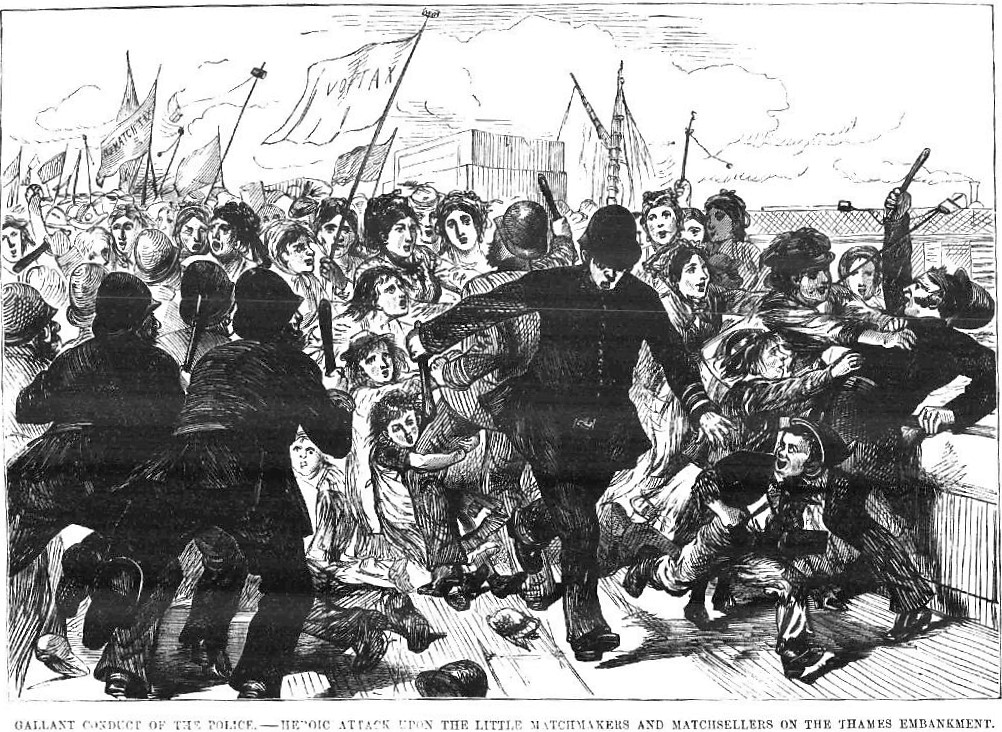
In June 1888, Annie Besant published "White Slavery in London" in her halfpenny weekly, The Link. She detailed the fines, the fourteen-hour days, the phossy jaw. Bryant & May summoned their workers and ordered them to sign a statement denying everything in it.
They refused.
So on July 5, 1888, Sarah Chapman and two other women walked out of Bow to find Besant. Fourteen hundred followed. The press called them the white slaves of London. The phrase was intended to shock the parlor. They wore it like a fist.
By November, Chapman stood as the Matchmakers' Union's first delegate to the International Trades Union Congress — one of ten women in a room of seventy-seven men.
■
The United Kingdom passed the White Phosphorus Matches Prohibition Act in 1908. It took legal effect January 1, 1910.
Twenty-two years after the strike. Sixty-six years after a safe alternative existed. Thirty years after Bryant & May acquired the patent for that alternative and locked it in a drawer.
■
In 2003, oral surgeons in the United States began noting a pattern. Patients taking bisphosphonates — drugs prescribed for osteoporosis and metastatic bone cancer — were presenting with exposed, dying jawbone that refused to heal. The drugs had accumulated in the mandible, where bone turnover is highest. When bacteria entered through the gums or a tooth socket, the jaw could not respond. The bone died inside the tissue.
The condition was named BRONJ: Bisphosphonate-Related Osteonecrosis of the Jaw.
Pathologically identical to phosphorus necrosis of the 1880s. Different patent. Same jaw. The paperwork showing someone had run the numbers was somewhere in the clinical trial records.
■
Phossy. The word the girls used. Phosphorus reduced to a soft, feminine diminutive by daily proximity to the thing. The language did what the bone did: lost its structure from the inside, shed what it couldn't hold, arrived at the diminished form.
The match was struck. The light lasted a second. In the tenement dark, the jaw of the girl who made it glowed for months — a longer, colder, privately witnessed light that no one in the Victorian parlor ever saw.
The chemical persists. The fog still gathers.
BRONJ is still here to remind us.
J.M.C. Kane
J.M.C. Kane is the author of the non-fiction book Quiet Brilliance: What Employers Miss About Neurodivergent Talent and How to See It (CollectiveInk UK). His prose work has been published in more than three dozen literary journals & magazines, including Plough, Camas, AMERICA Magazine, Commonweal, Smokelong Quarterly, and The New Ohio Review, where his essay, “Nomenclature of a Life”, cataloguing his experience as an ASD-1, was awarded the 2026 Ellis Prize for Non-Fiction He lives in New Orleans with his family where he works as an environmental attorney.
![]()
Back to Issue
Also in this thread
This thread has no other posts