BROWSE Columns


✕


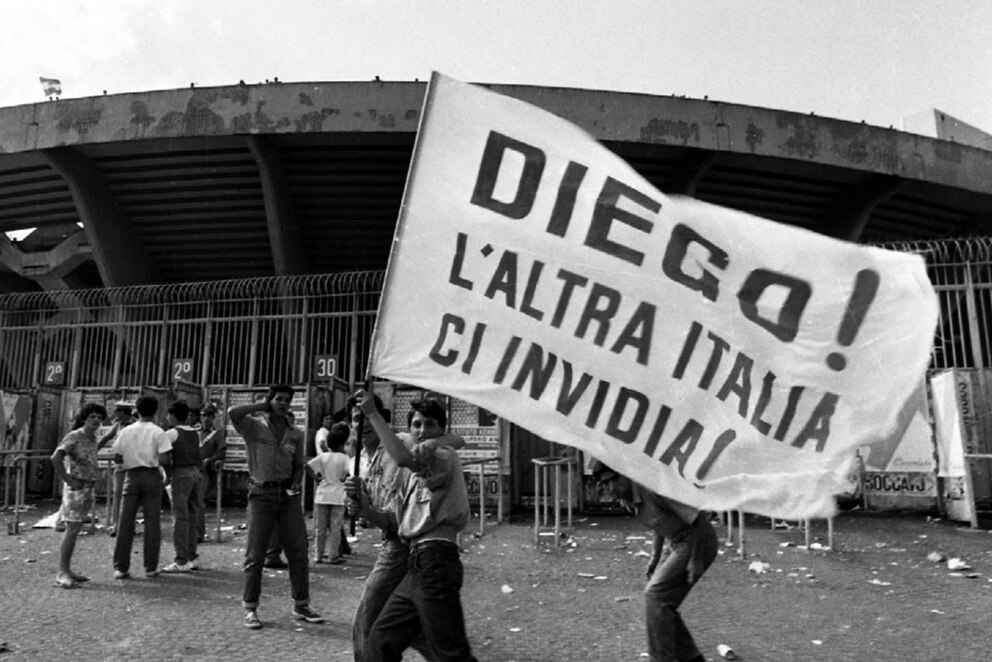
To understand why at five in the afternoon on that Sunday, Piazza Dante was a tide of sky-blue and white smoke and shredded throats, one must go back four decades. In July 1984, when a downcast Maradona stepped onto the grass of the San Paolo stadium for the first time (today renamed after him, as befits lay saints), he wasn't just a football player arriving; a plebeian messiah was disembarking, coming to collect an old historical debt from the Italian aristocracy.
The kid from Villa Fiorito, forged in the mud of Argentine potreros, represented something more than pure talent: the possibility that someone from the bottom could challenge those who seemed destined to win forever. The two scudetti that Diego snatched from Juventus and Milan were not mere sports titles: they became a proletarian slap in the face to the economic power of the North.
In an Italy fractured by the economic contempt of the industrial North toward the impoverished South (where the stadiums of Turin and Milan used to spew xenophobic insults against Neapolitans with infamous banners begging "Vesuvius, wash them with fire") those championships of 1987 and 1990 were not decided on the pitch, but on the battleground of social dignity. That a humble club from the Mezzogiorno, led by an Argentine kid playing with the defiance of the marginalized, managed to bring down the billionaire cartels of the North was no conventional athletic feat; it was the symbolic revenge of the disinherited, the day the southern proletariat struck back against dominant history.
That is why, four decades later, Naples' effervescence for the Albiceleste is not a passing sympathy, but a bloodline woven by shared migrations, by the literature of failure, and by a secular religion where San Gennaro and the number 10 share clandestine altars in the Quartieri Spagnoli.
Aurora Marino, a Neapolitan woman waving an Argentine flag in Piazza Dante, says she never saw Maradona play live. She knew him through her parents' stories, through family nights where Diego felt like someone close, almost like another member of the household.
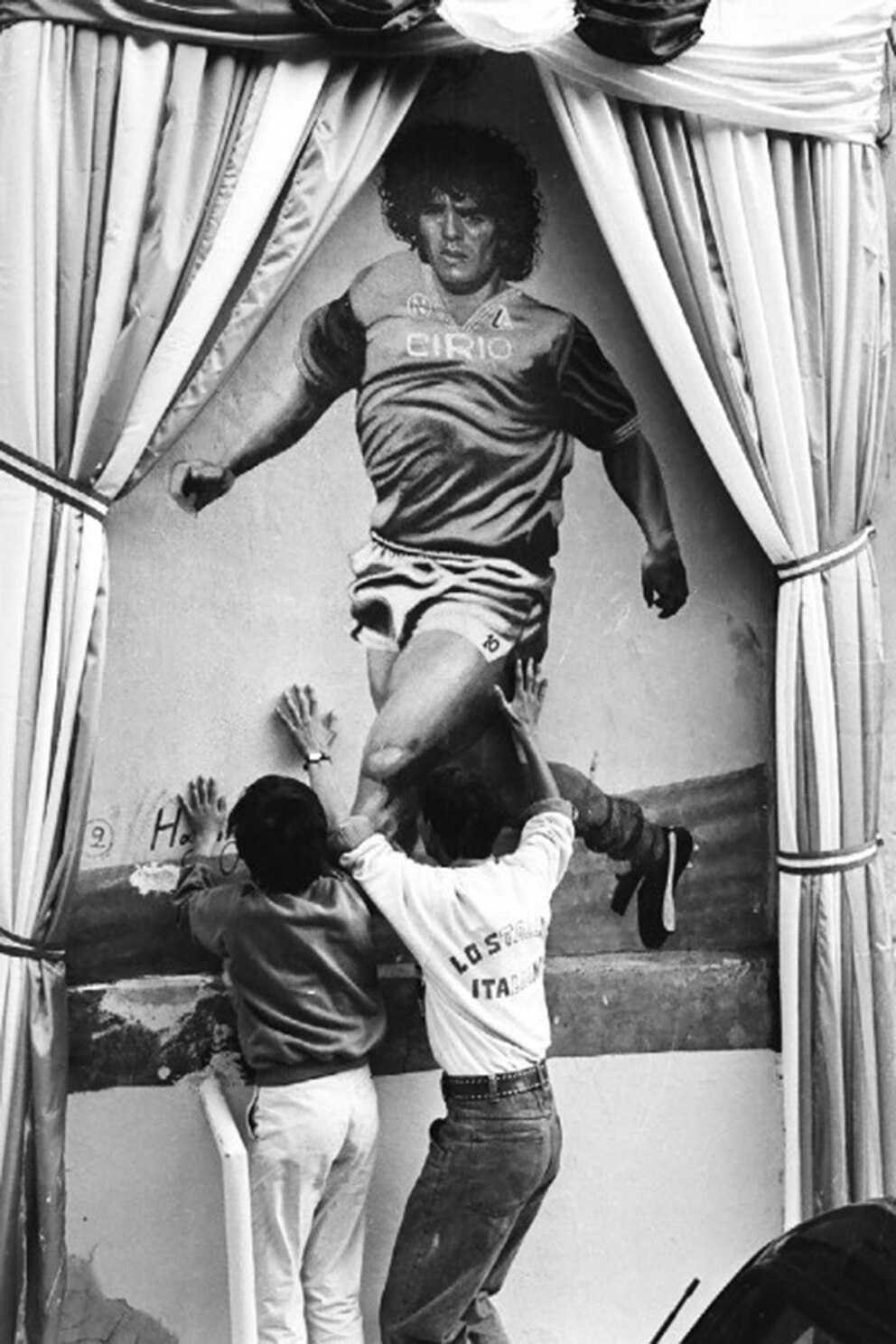
For her, Argentina is not just a team. It is the country of the man who changed the destiny of a city. That is why in Naples, Maradona is not merely nostalgia, but a living presence. His face appears on murals, tattoos, phone wallpapers, and small improvised altars. In very few places in the world has a footballer managed to occupy a space so close to that of faith.
For the 2026 World Cup final, the gathering that filled the square was born from the spark of a WhatsApp group called "La selección a Napoli", a magnet that early on drew Argentines scattered across different cities in Italy and Europe, because they knew that being in Naples meant being at home.
Thus, at five in the afternoon, Piazza Dante was already roaring with its own liturgy. The bass drums echoed against the cobblestones, raising a mist of flares and the scent of gunpowder. Among the voices, chants of ¡El que no salta es español! and Por Malvinas, por el Diego, por la última de Leo blended together, while Muchachos, ahora nos volvimos a ilusionar" spilled out into the streets of the historic center with a Neapolitan accent. At the heart of that human whirlwind, shirtless beneath the unforgiving July sun, stood Salvatore Imparato.
Salvatore is a legitimate son of Naples who carries Maradona's number 10 jersey tattooed stroke by stroke across his entire back. His skin is an archive of passion. When Salvatore climbed onto a platform and opened his arms, mimicking Diego's silhouette in flight, the entire square erupted into a howl, the very same shout these kids' grandfathers unleashed when the South finally managed to twist the arm of power.
That legacy continues to shake the city's foundations. Tommaso Tascone, a Neapolitan tour operator who knows the inner workings of the port, sums it up with a phrase as brutal as it is revealing: Maradona has left more money in Naples dead than alive, and that is saying something, considering that in life he did the impossible to lift it up.
After his death in November 2020, and despite pandemic restrictions, it was the Neapolitans themselves who spontaneously crowded around the stadium to demand that the concrete colossus bear his name. Since then, the constant pilgrimage of the curious, devotos, and football lovers has transformed Diego’s memory into a parallel economy. Murals, guided tours, hostels, shops, restaurants, and small startups now thrive, in part, off that devotion.
To Tommaso, in Naples, Maradona stands above the Pope and San Gennaro himself. That is why, whenever Argentina plays, Naples feels for a few hours more Rioplatense than Mediterranean. Here, instead of watching cartoons, kids learn through matches why "El Pelusa" ended up becoming the pagan god of the Italians.
Football, like history, is rarely merciful to sentimentalism. This 2026 had dragged the Argentine national team through a ordeal of attrition, a thorny path where the generational transition rested on the stamina of the veterans and the usual core, all under the gigantic, inescapable shadow of Lionel Messi.
Messi reached this final with his body stretched to the limit, dragging his legs as if every square meter of the MetLife Stadium grass weighed more than usual. For the man from Rosario, this was the final act of a tragedy: the end point to two decades of media persecution, of battles won in the mud, and of trying to step into (unsuccessfully, for some) Maradona's impossible boots.
In every short sprint, in every weary jog, there still beat the determination of a man who refused to accept that time, and time alone, could defeat him.
With the kickoff, the fired-up crowd in Piazza Dante dispersed into the bunkers of the alleyways: cramped bars tucked beneath stone arches where the air smelled of frying oil from pizze fritte, black coffee, and the bitterness of limoncello to numb the racing hearts.
Among those seeking shelter there was Alina Banda, an Argentine woman whose life had revolved around the national team and Maradona for years. Her devotion had brought her together with Ciro Imparato, a Neapolitan of pure pedigree and Salvatore's brother. What began as a conversation about football ended up becoming a family, confirming an intuition that feels inevitable in Naples: there are bonds that Maradona continues to weave even after death.
Spain controlled the match with Rodri’s methodical insolence and the sudden strikes of Lamine Yamal. Alina didn't take her eyes off the television. She clutched the folds of the same sky-blue and white jersey, a superstition against mufa (bad luck).
"I always wear this one. I haven't even washed it."
Every Spanish attack severed her sentence; when the danger receded, she picked up the thread of the conversation again.
"We are united by economic crises, migration, that feeling of coming and going in search of a better place."
On screen, Dibu Martínez closed down spaces with loud roars. At the tables, glasses clinked against the pewter counters every time the ball entered the Argentine box. The game turned into a quagmire of fouls and complaints where Italian and Spanish fused into a single curse.
Alina looked back at the TV before finishing her thought.
"We are passionate people. Politics wrecks our country, and foobtall ends up being the only way to purge it."
The July heat seeped in through the open doors. The tension was unbearable until, in the final stretch of regulation time, the dream seemed to shatter: Enzo Fernández, suffocated by the pressure, received a second yellow card after a desperate tackle, leaving the Albiceleste down to ten men.
In a corner, an old man in a wine-stained cap struck the table with his knuckles:
"Ci hanno fottuto."
He said it with the same inherited rage with which entire generations learned to distrust the power coming from the North.
.jpeg)
With a man down, the Argentines ran on sheer inertia; Messi dragged his legs across the Yankee turf, searching for one last spark that his body could no longer provide.
Then came the inevitable. In the 106th minute, a cross found Ferran Torres completely unmarked at the far post: a low left-footed strike, the net bulging, 1-0 for Spain. The blow fell over Naples like the silent eruption of Vesuvius. On the screens, the distant celebration of the Spaniards exploded; in the bar, the air became unbreathable.
Alina reached for Ciro's hand without breaking her gaze from the screen. He squeezed it in silence. There was no longer anything left to argue with the referee.
There was no coronation. Messi's last dance ended on the shore, chewing on the silver medal of a World Cup that slipped through their fingers. The lights along Via Toledo began to flicker, and the crowd dissolved once again back into the alleyways in a silence that no one seemed willing to break.
Salvatore received a pat on the back. Maradona's number 10 glistened with sweat under the midnight gloom. In Naples, they had learned a truth much older than football long ago: victories are celebrated and never forgotten; defeats, on the other hand, end up becoming identity.

Isabella Portilla is a Colombian writer. She is the author of Malandrines (Planeta), and holds degrees in Journalism and Philosophy, as well as an MFA in Creative Writing from NYU. She has lived across Latin America, the United States, and Europe, where she has developed her work.


